







Condo buyer’s market HOA costs can outweigh a lower asking price. In our fictional comparison, a $15,000 price cut reduces monthly principal and interest by about $75.85. However, $250 higher association dues leave the modeled monthly bill about $174.15 higher. The building’s obligations therefore belong beside the sale price from the start.
This report pairs September 2026 market evidence with an original, reproducible budgeting exercise. It includes five charts, a three-ledger infographic and four CSV tools. The scenarios are examples rather than quotations, forecasts or advice to buy a particular property.
What the September condo buyer’s market actually shows
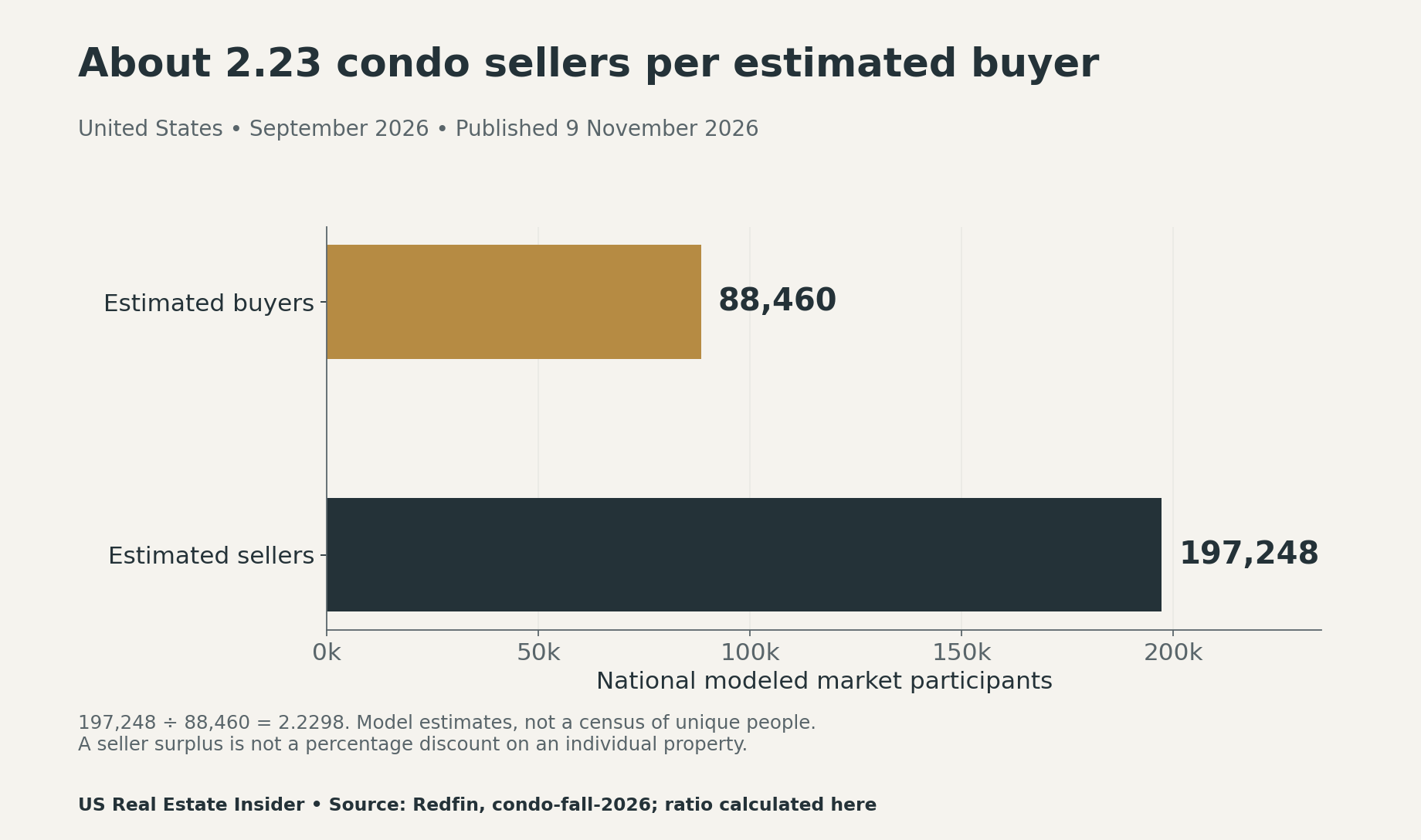
Redfin’s report published November 9, 2026 estimates 197,248 condo sellers and 88,460 buyers nationwide in September. Dividing those figures gives about 2.23 sellers per buyer. Its rounded seller surplus was 123%, compared with 95.5% a year earlier.
These are modeled market estimates. Redfin combines proprietary information about tour-to-closing time with multiple-listing-service data; it does not count every individual buyer. The figures describe national conditions, not a building’s finances or your likely negotiated discount.
For that reason, start with a narrower question: what does each complete ownership package cost you? Two similarly priced units can include different services, insurance arrangements and repair obligations. A low advertised payment cannot answer that question by itself.
A $15,000 discount and $250 higher dues: the simple screen
First, consider a deliberately limited benchmark. An extra $250 each month adds up to $3,000 a year. After five years, the additional dues total $15,000, equal to the assumed purchase-price difference. Both inputs are fictional and remain unchanged in this screen.
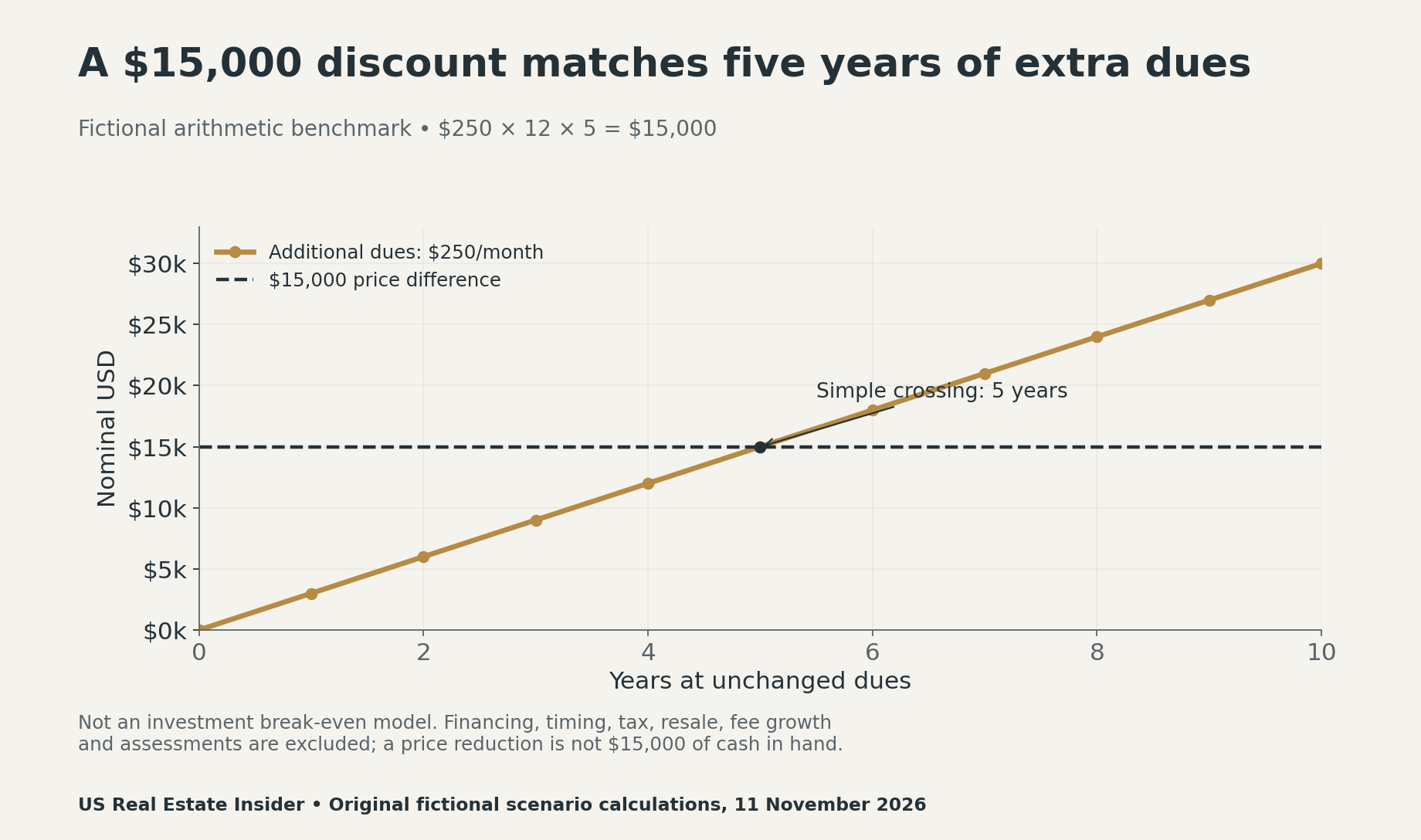
This calculation is useful because it makes a recurring charge visible. Nevertheless, it does not turn a price reduction into spendable cash. A financed buyer normally spreads part of the price difference through the loan balance. Taxes, timing, resale value and changes in dues also affect a fuller comparison.
Use the screen to identify questions, then replace it with a monthly budget and a separate cash ledger. Otherwise, you risk comparing a one-time price difference with a recurring expense while overlooking how either amount is paid.
Compare condo buyer’s market HOA costs with financing
Our next example holds the financing assumptions constant: 20% down, a 30-year fixed loan and a 6.5% annual interest rate. The rate is an illustrative input, not a current offer. We also assume $300 monthly property tax and $100 unit insurance for both properties, solely to isolate the price-and-dues tradeoff.
| Fictional input or result | Property A | Property B |
|---|---|---|
| Purchase price | $339,000 | $324,000 |
| 20% down payment | $67,800 | $64,800 |
| Base loan | $271,200 | $259,200 |
| Monthly principal and interest | $1,714.17 | $1,638.32 |
| Monthly HOA dues | $450 | $700 |
| Assumed tax plus unit insurance | $400 | $400 |
| Modeled monthly total | $2,564.17 | $2,738.32 |
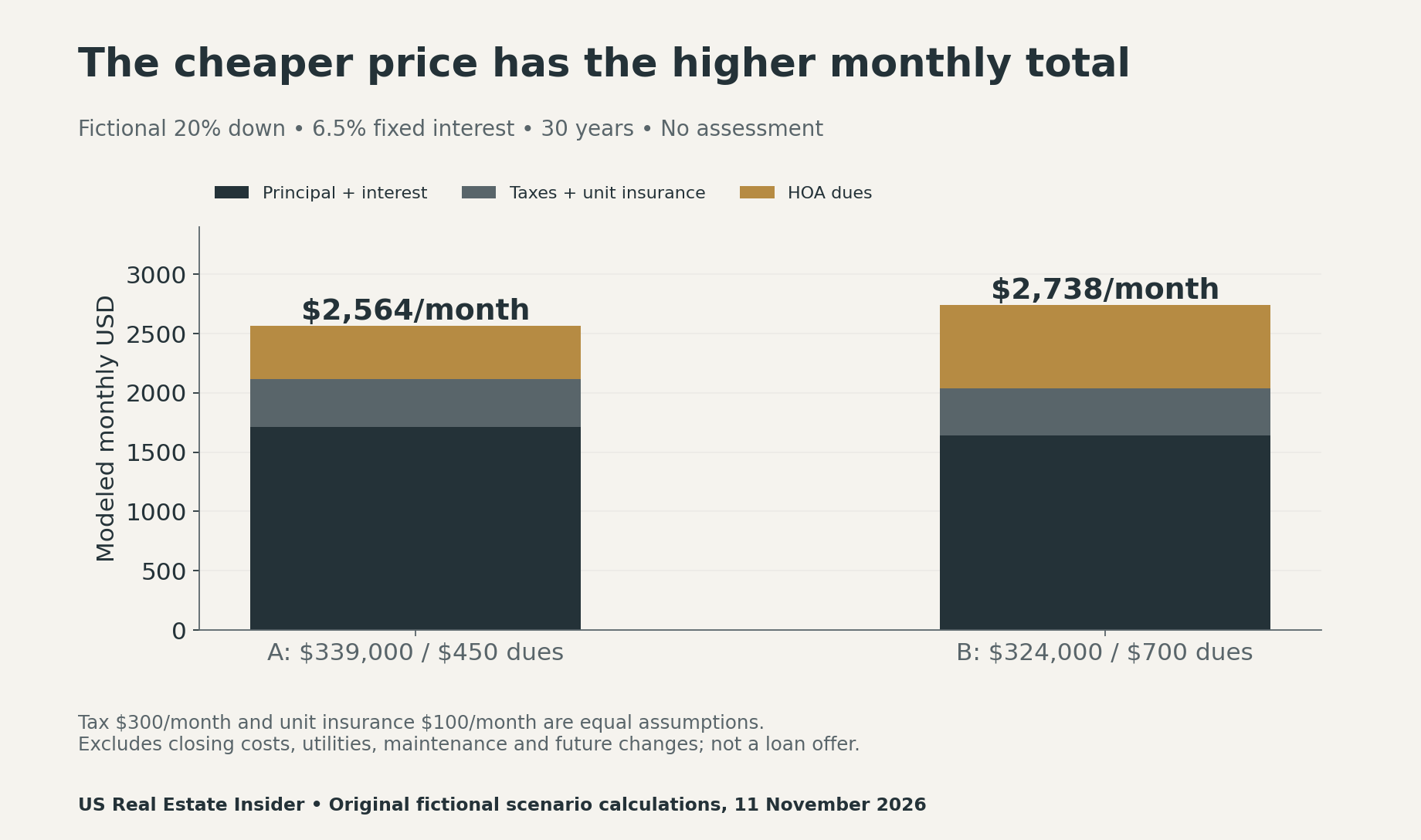
Property B needs $3,000 less for the down payment and has a $12,000 smaller base loan. Those are different benefits with different timings. Neither equals $15,000 available immediately for future association charges. Actual closing costs and the cash you retain still need their own entries.
The Consumer Financial Protection Bureau explains that HOA dues usually go to the association separately from the mortgage-servicer payment. Therefore, confirm what a quoted payment includes before comparing it with another property.
Keep three ledgers instead of one headline number
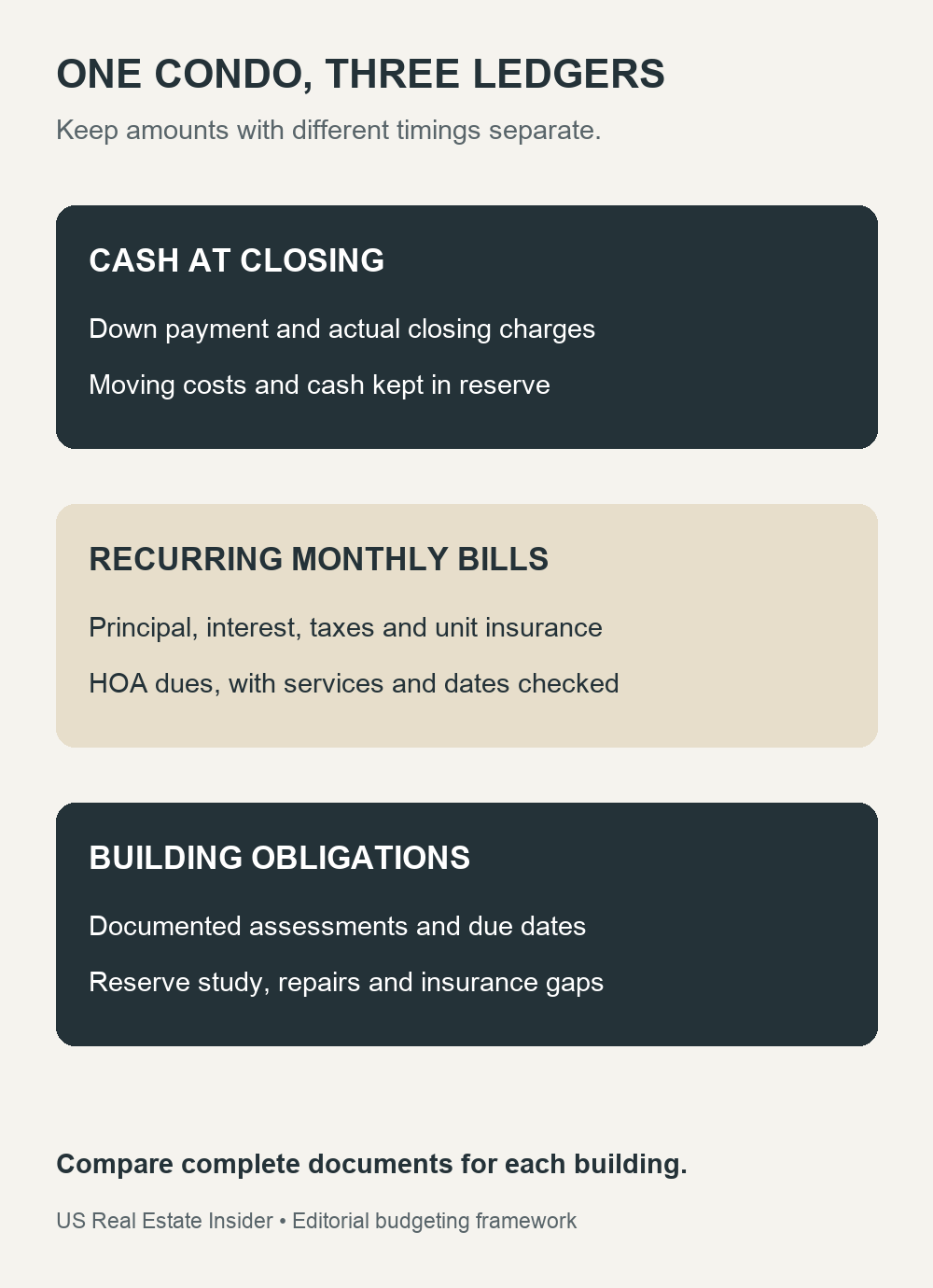
In the closing ledger, enter the actual down payment, lender charges, prepaid items and moving costs. Then show the cash remaining. In the monthly ledger, list recurring obligations separately. Finally, keep a dated register of assessments, major works and other documented building obligations.
Do not add an assessment to monthly dues unless a documented payment schedule allows that treatment. An immediately payable charge is a cash requirement now. A planned repair with no approved allocation is an unresolved question, rather than a precise bill you can confidently enter.
Also compare what the dues buy. One building might include services that another bills separately. Record each included service and remove duplicates from your personal budget. Higher dues alone do not prove poor management; lower dues alone do not prove adequate funding.
Stress-test assessments without inventing their probability
Suppose, separately, that a buyer retains $20,000 after all closing and moving costs. An immediately payable $6,000 assessment leaves $14,000. A $12,000 assessment leaves $8,000, while $24,000 creates a $4,000 funding gap. These are arithmetic cases, not estimates of the chance that any building will assess owners.
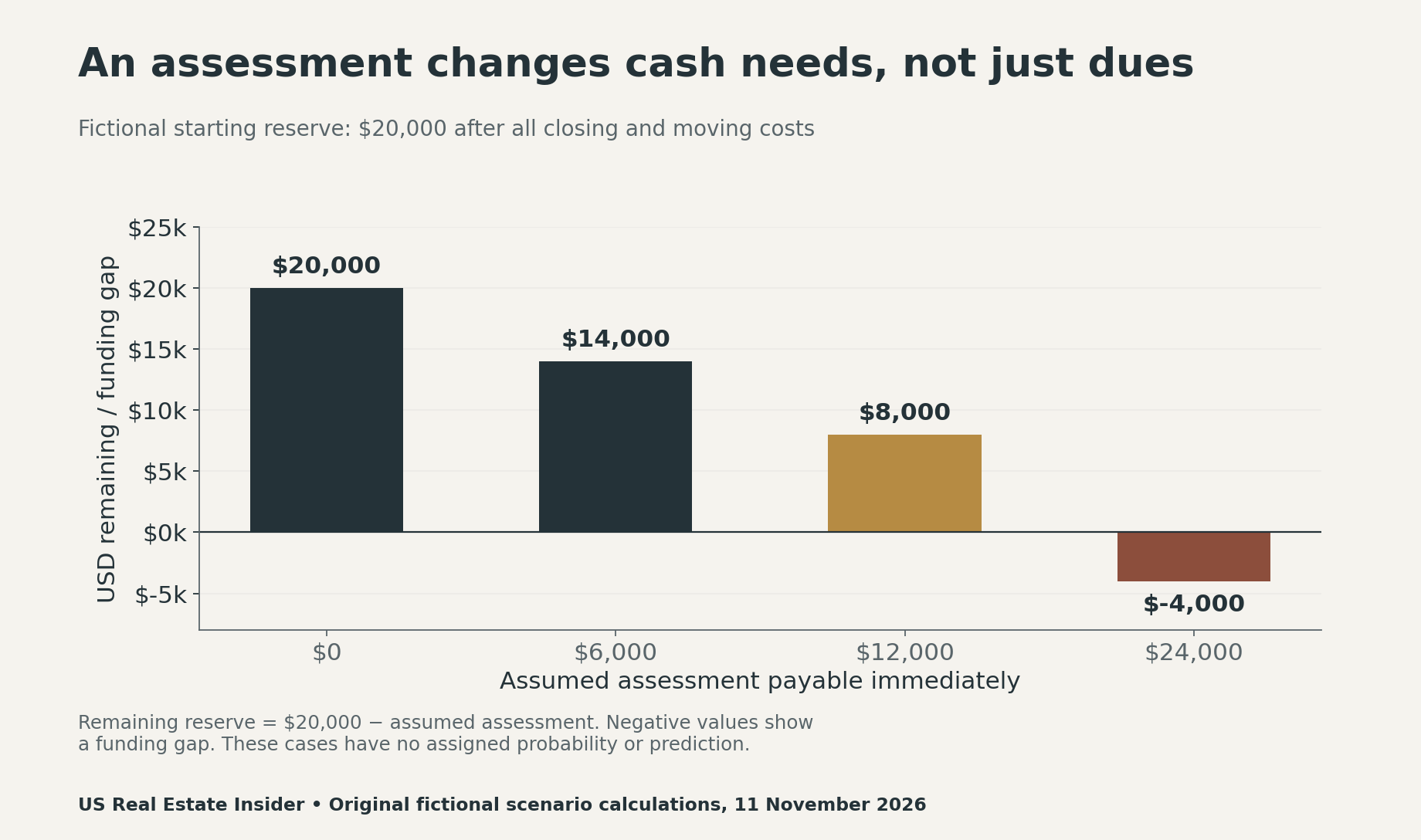
Next, replace the assumed charge with the building’s actual notices and due dates. Ask your local adviser to check responsibility under the contract and applicable rules. Do not assume that a seller automatically pays every charge or that every jurisdiction offers the same review period.
Find the monthly dues threshold, then check the documents
In this financing example, the lower price saves about $75.85 each month in principal and interest. Thus, an HOA premium near $75.85 uses up that modeled monthly saving when other listed costs are equal. Above it, Property B has the higher modeled monthly outlay. This threshold says nothing about investment returns or building quality.
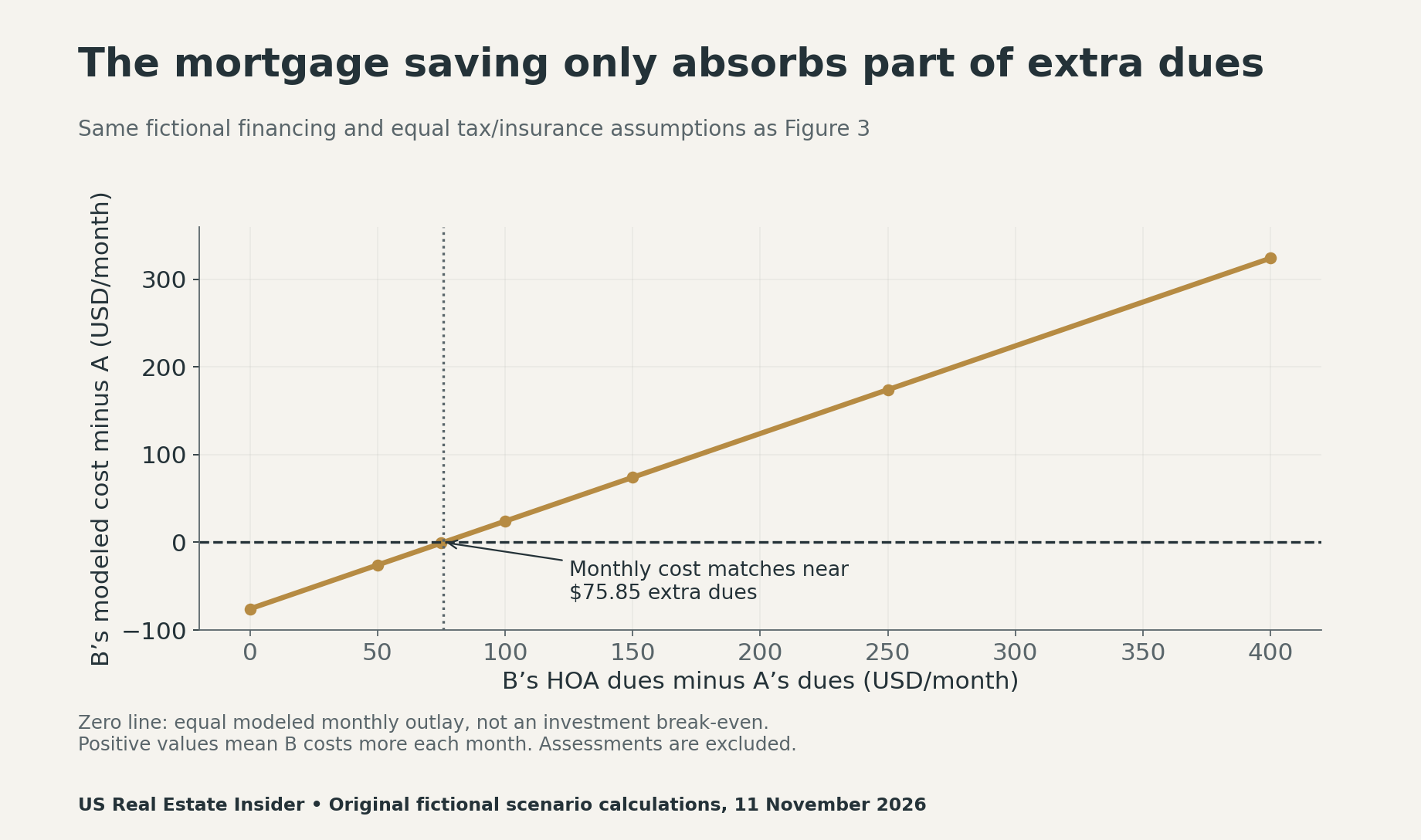
Fannie Mae’s condo guidance points buyers toward questions about reserves, assessments, major components and insurance. Our blank checklist helps you organise those questions. It does not grade a reserve study or determine a lender’s project eligibility.
- Obtain the current budget, reserve study and funding plan; record their dates.
- Read assessment notices and payment schedules, including who owes what and when.
- Compare the master insurance policy with a property-specific unit insurance quotation.
- Review relevant meeting minutes and ask about unresolved repair or funding questions.
- Check written loan, tax and closing estimates; seek local professional review of contractual obligations.
Download the source data and comparison tools
The four CSV files preserve the reported evidence, the fictional inputs and the comparison logic. Open them in a spreadsheet and keep an untouched copy. A CSV stores values rather than an interactive calculator, so the formulas below explain how to reproduce or change the example.
- Source-data register (CSV): four reported fields with periods, units and caveats.
- Two-property ownership comparison (CSV): fictional prices, financing inputs and calculated monthly totals.
- HOA premium sensitivity table (CSV): change one assumption while keeping the rest fixed.
- Blank condo document checklist (CSV): eight checks with empty evidence and follow-up fields.
Method, limits and a practical next step
We calculated sellers per buyer as 197,248 ÷ 88,460. For the mortgage examples, monthly principal and interest equals L × r ÷ [1 − (1 + r)−n], where L is the base loan, r is annual interest divided by 12, and n is 360 monthly payments. We calculate at full precision, then round displayed dollars to cents.
The monthly comparison adds principal and interest, assumed tax, assumed unit insurance and HOA dues. The sensitivity table subtracts the $75.8481628192 principal-and-interest saving from each assumed HOA premium. The cash stress test subtracts the assessment from the separate $20,000 starting reserve.
This is not a total-cost-of-ownership or investment model. It excludes closing charges, utilities, maintenance, opportunity cost, tax effects, sale proceeds and future changes in fees or rates. It does not value amenities or establish a safe reserve level. National modeled demand cannot diagnose a specific building.
For related context, see our first-time buyer survey analysis and guide to comparing mortgage terms. Then build two complete, dated property budgets. The useful question is whether the combined cash needs, recurring costs and documented obligations fit your circumstances.
Suggested citation: US Real Estate Insider, “Condo Buyer’s Market HOA Costs: Does the Discount Last?”, November 11, 2026. Source evidence: Redfin’s September 2026 estimates, released November 9. All ownership-cost cases are original fictional calculations dated November 11, 2026.