


A property can hit a value limit before it hits an income limit—or the other way around. In our fictional refinance, the value-side bound is $10.40 million. At $1.20 million of stipulated annual income, the coverage-side bound is about $11.29 million, so the lower amount controls this two-bound exercise. At $1.05 million, the coverage bound falls to about $9.88 million.
This commercial mortgage refinance proceeds DSCR LTV worksheet explains that arithmetic without turning a market headline into a lender offer. All property values, income, ratios, constants and closing uses below are invented teaching inputs. We assessed no property, borrower, appraisal or term sheet.
What the latest origination figures measure
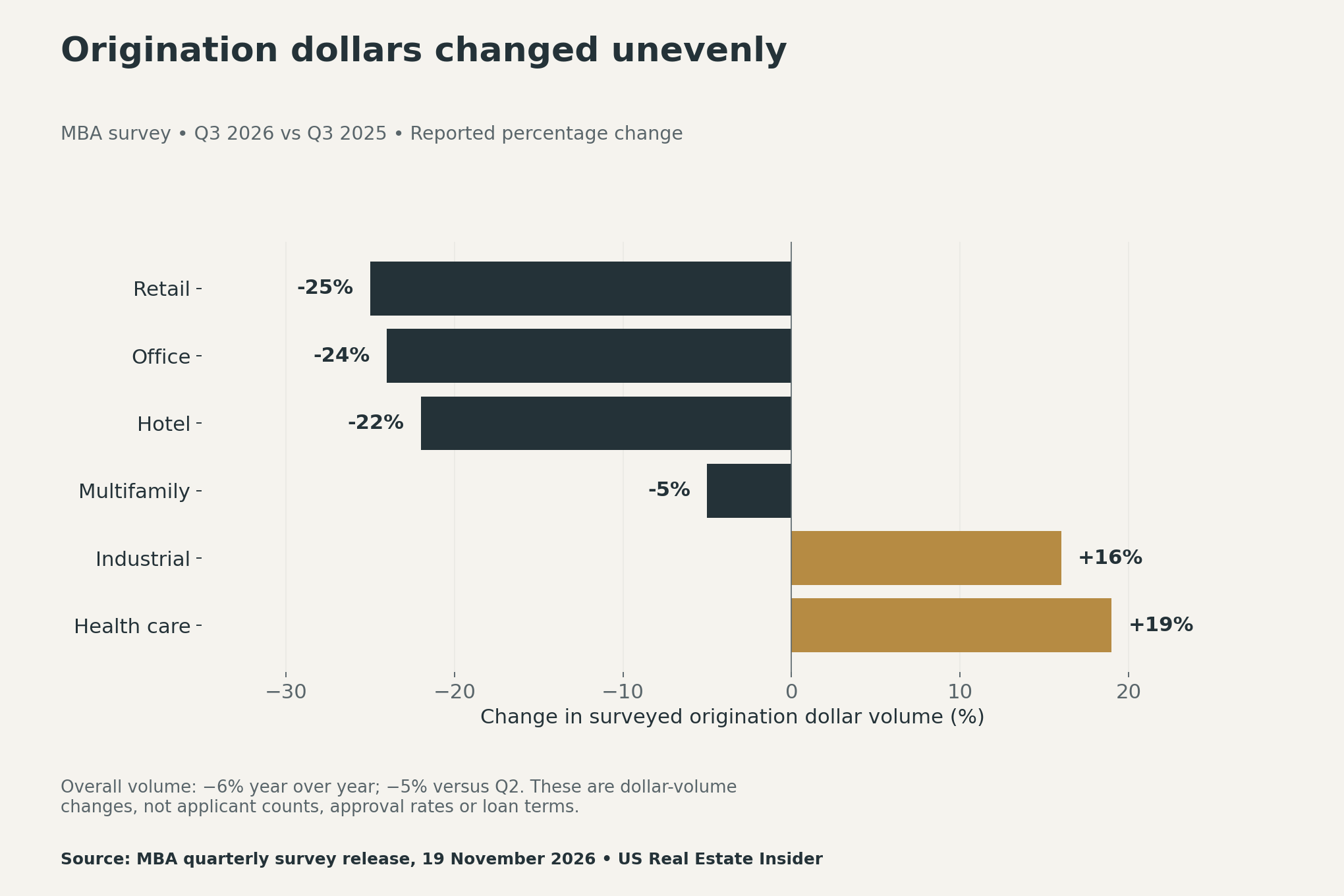
The MBA release dated November 19 reports Q3 2026 commercial and multifamily mortgage origination dollars down 6% from a year earlier and 5% from Q2. Industrial and health care increased year over year; retail, office, hotel and multifamily declined. The figures describe surveyed lending volume, not approvals, applicant counts, interest rates or individual refinance offers. The first-party indexed release was readable; direct access was blocked during our check.
Consequently, subtracting 6% from your existing loan balance would answer no supported underwriting question. Market volume can change because of many transactions and circumstances. Our model therefore starts a separate ledger with explicit property-level assumptions. It does not use the survey decline as a discount factor.
List the two different constraints
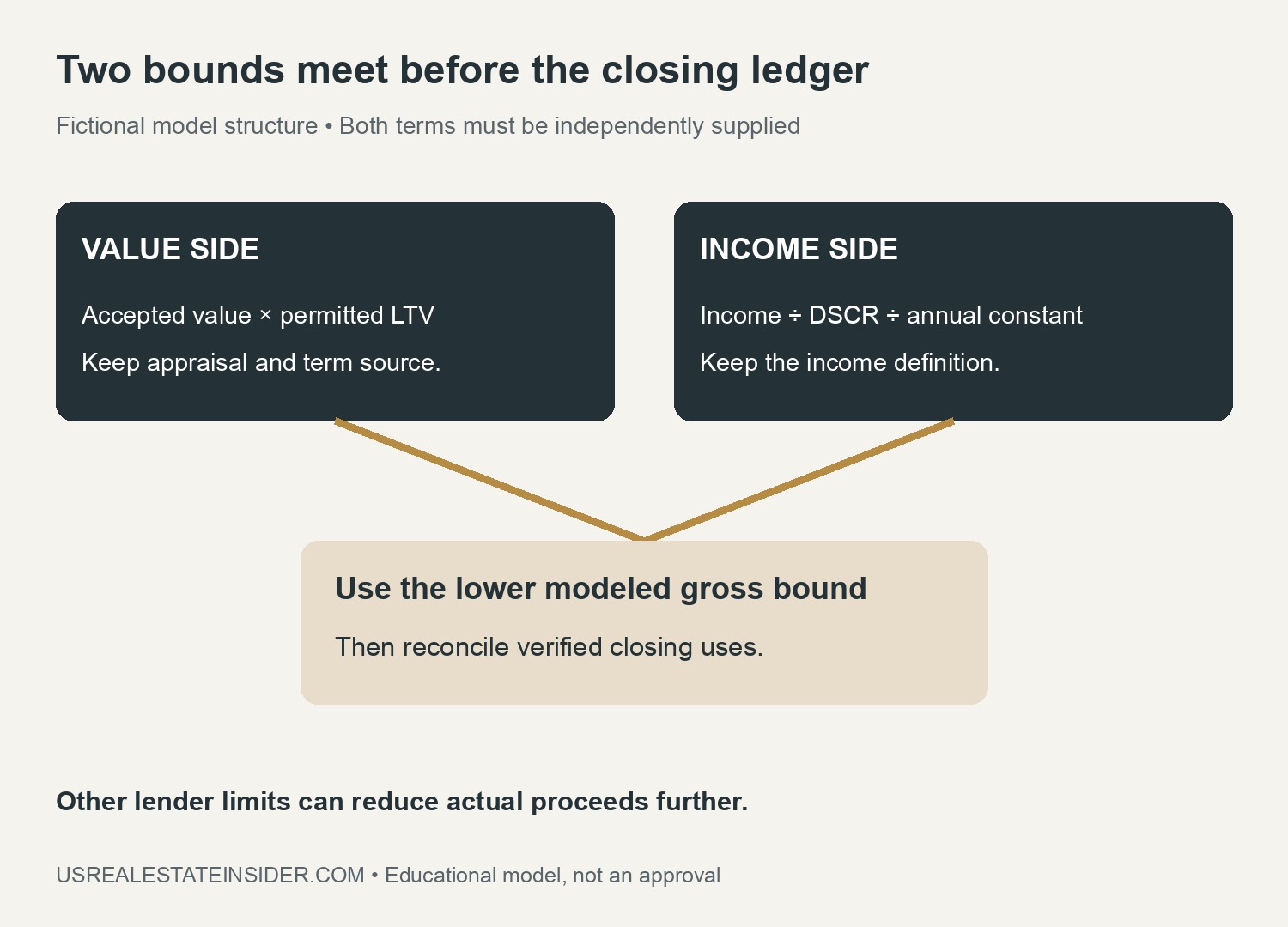
For the value side, stipulate an accepted property value of $16 million and a maximum loan-to-value ratio of 65%. Multiplication gives $16,000,000 × 0.65 = $10,400,000. This is a model input pair, not a claim that a lender would accept that value or ratio for a real asset.
For the income side, define the income measure before calculating. Fannie Mae’s glossary uses net cash flow in its coverage definition; its underwriting guidance also refers to an amortizing debt-service constant. Those product-specific definitions are a reason to confirm a lender’s own terms. Our example simply stipulates annual NOI and the ratio used with it.
Calculate the coverage bound at full precision
Set minimum debt-service coverage at 1.25 and the annual mortgage constant at 8.5%. With $1.20 million of annual NOI, allowable annual debt service is $1,200,000 ÷ 1.25 = $960,000. Dividing $960,000 by 0.085 gives $11,294,117.65 before display rounding. The comparison keeps the full result behind the chart.
The constant is annual debt service divided by principal. It is not the note interest rate. Replacing one with the other can change the result even when the percentage looks plausible. Check payment structure, amortization and the period attached to every input rather than importing a rate from a separate quotation.
| Fictional case | Value bound | Coverage bound | Lower gross bound |
|---|---|---|---|
| A: NOI $1.20m | $10.40m | $11.29m | $10.40m |
| B: NOI $1.05m | $10.40m | $9.88m | $9.88m |
A lower income assumption changes the binding side
Case B changes only annual NOI to $1.05 million. Allowable debt service becomes $840,000, and the income-side amount is $840,000 ÷ 0.085 = $9,882,352.94. The value-side result stays $10.40 million. This time the coverage side is lower. It is a sensitivity example, not an estimate of a future operating decline.
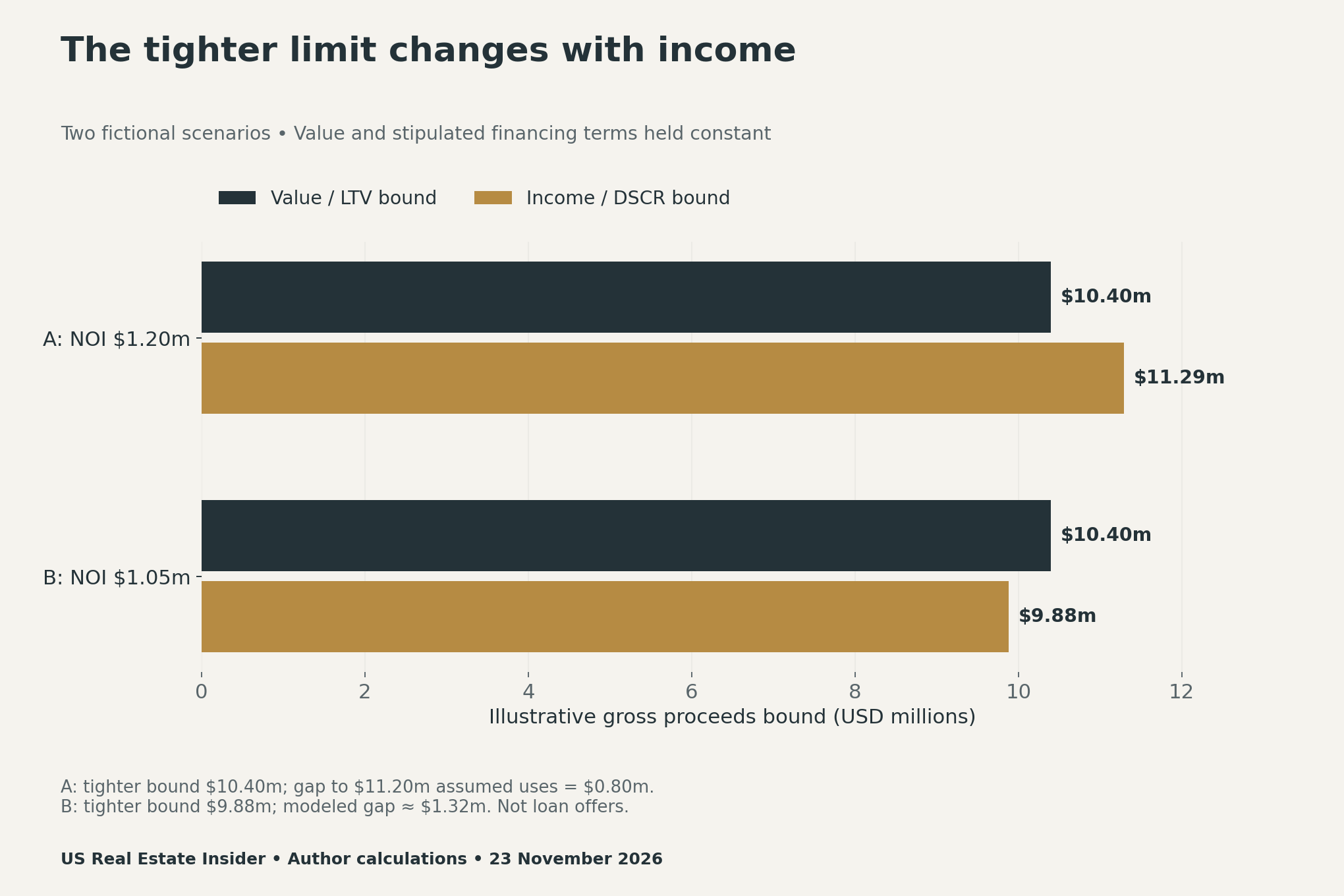
Also keep a lower bound separate from cash available to the owner. In both examples, assume total closing uses of $11.20 million solely for the exercise. Case A then leaves an $800,000 modeled gap. Case B leaves about $1.32 million. Those comparisons come before any additional restriction omitted from the model.
Reconcile uses without counting the same item twice
A real working ledger needs a dated payoff, fees, reserves and any other relevant uses, with each item’s treatment confirmed. For example, a reserve might already be included in a total supplied by someone else. Adding it again would create a second error even if the loan-bound formula were correct. Our blank ledger gives those items separate evidence fields.
Ask which amount is gross principal, which charges are withheld and what the stated proceeds actually mean. Leave an unknown term open instead of substituting a market headline. Our refinance denominator guide explains another measure distinction. The forecast assumption ledger shows how to preserve dated inputs.
Method and downloadable evidence
Research checked November 23, 2026. We transcribed the MBA release’s reported changes and calculated two independent fictional scenarios. The workbook uses no observed financing offer, lender-approved NOI, appraisal or actual closing obligation. Lender definitions, reserves, fees, amortization and covenants can materially alter real results. This is educational arithmetic, not financing advice or a market-capacity estimate.
- MBA reported origination changes and comparison periods (CSV)
- Two fictional refinance constraints with full-precision results (CSV)
- Blank refinance input and closing-use ledger (CSV)
- Primary-source and assumption register (CSV)
Suggested citation: US Real Estate Insider, “Commercial Mortgage Refinance Proceeds: Which Limit Binds?”, November 23, 2026. Credit MBA for survey figures and this report for the original fictional constraint comparison. Do not describe the scenario amounts as observed offers.