


A fictional 100-home redevelopment can contain only 40 homes in the relevant replacement count. At the general $350,000 cap, that gives $14 million of illustrative cap arithmetic. Multiplying every proposed home produces $35 million and an overstatement of $21 million. Neither result is an award, and this exercise assesses no real project.
This guide to Massachusetts public housing redevelopment funding 2027 separates the unit count from the funding status. It gives housing reporters, authority teams and development partners a reproducible example, two charts and four CSV tools. Use the blank ledger to record evidence; do not treat a completed spreadsheet as a substitute for the authority’s decision.
What the November notice establishes
EOHLC’s PHN 2026-17, dated November 20, addresses local housing authorities redeveloping state-aided housing. It offers approximately $25 million in capital, a general cap of $350,000 per qualifying replacement unit, early-stage predevelopment awards up to $400,000 and up to 40 MRVP vouchers. It requires added housing, chiefly financed elsewhere, and identifies a possible non-tax-credit cap exception. Full capital is not released before financial closing.
Applications are due January 22, 2027 at 5 p.m. The narrative plans spring 2027 awards, but its later table prints spring 2026. That inconsistency needs confirmation; no award date is established here. Verify current amendments, approved classifications and tenant protections with EOHLC and the authority before relying on a project-specific interpretation.
Count replacements separately from net-new homes
Start with a row for each distinct unit group. In our invented plan, 40 units are stipulated to qualify as replacements and 60 are net-new. The sum is 100 homes, but the sum does not define every program’s funding base. Keep the classification evidence alongside the number so another reader can see where it came from.
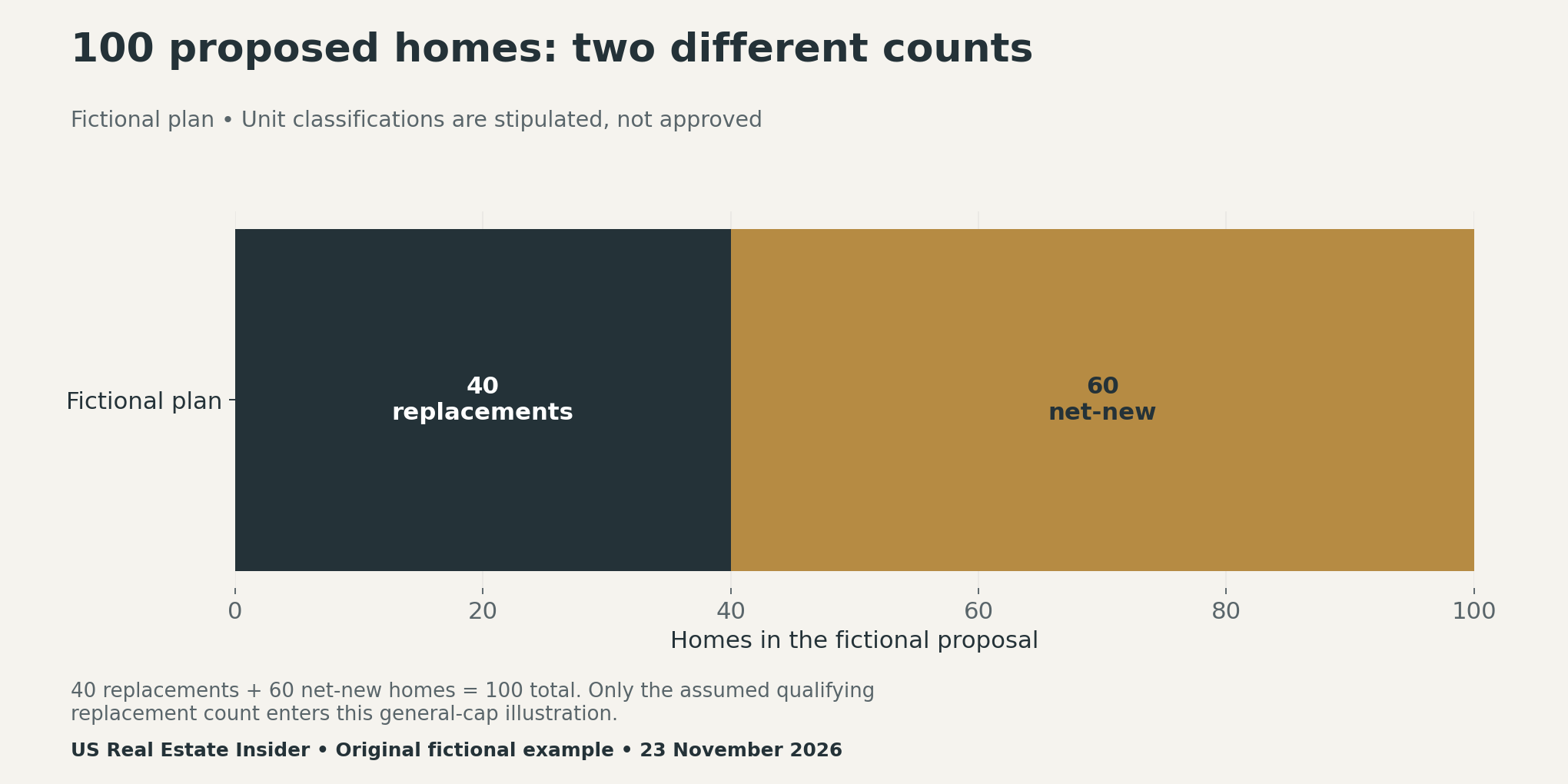
For example, a headline can accurately say that a proposal would contain 100 homes and still give the wrong impression about the cap. The fix is to show the two counts together. A reader should not have to infer which units the multiplication includes from a paragraph several pages away.
The worksheet deliberately leaves real classification evidence blank. Fill it only from a named, dated record, and keep uncertain units unresolved. A missing decision is not zero eligibility, and a preliminary label is not final approval. If the classification changes, update both the table and the calculation rather than changing the total alone.
Reproduce the $14 million calculation
| Illustrative calculation | Result | Interpretation |
|---|---|---|
| 40 × $350,000 | $14,000,000 | General-cap arithmetic with stipulated qualifying replacements |
| 100 × $350,000 | $35,000,000 | Incorrect multiplication of every proposed home |
| $35m − $14m | $21,000,000 | Overstatement caused by the wrong unit base |
The difference is auditable: the extra 60 units multiplied by $350,000 produce $21 million. That is the entire numerical error in this deliberately simple example. It says nothing about a real project’s construction budget, financing gap, competing applications or potential exception. Keep those questions outside this multiplication.
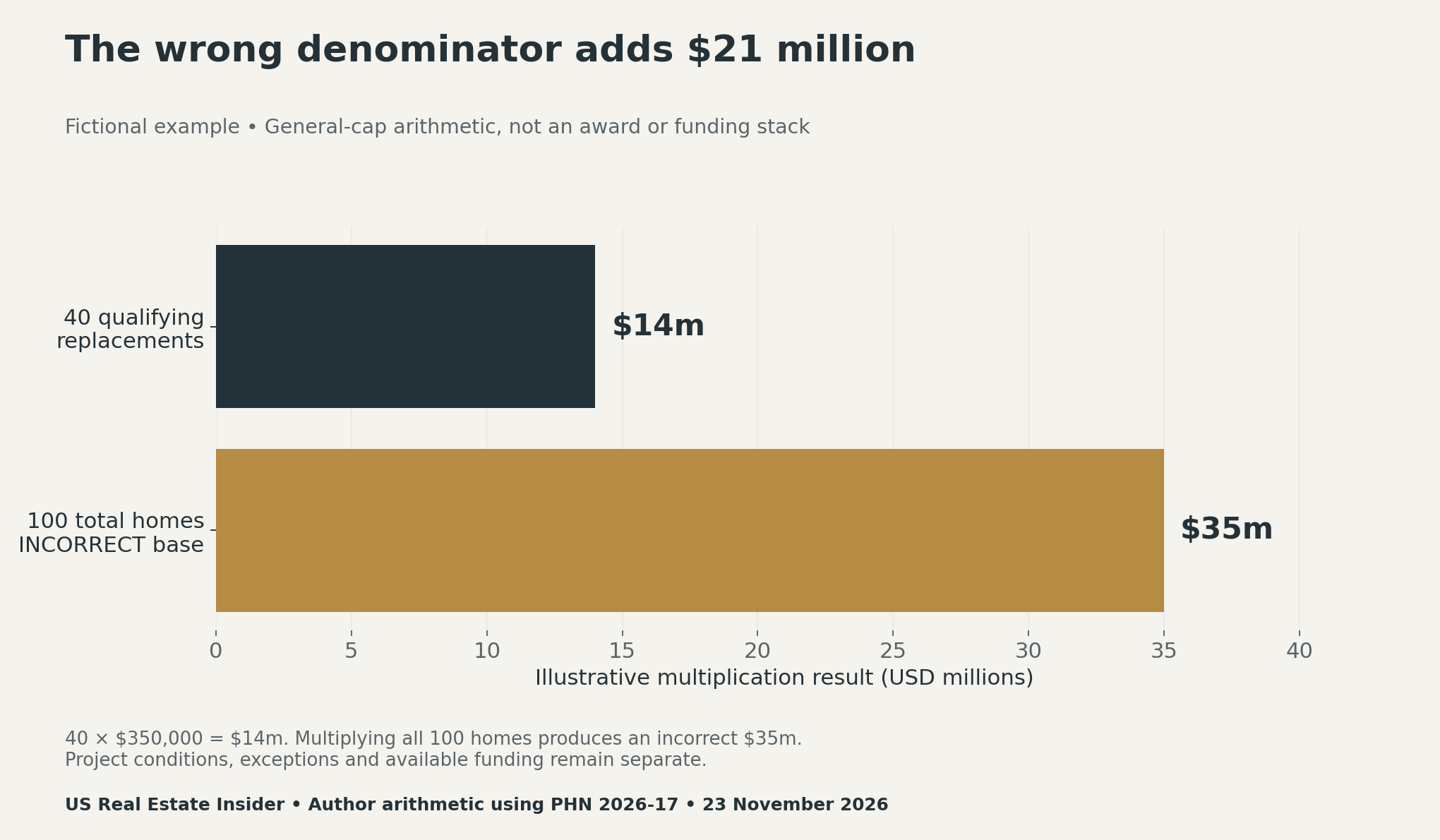
Also avoid calling $14 million a complete funding stack. This report supplies no other capital sources or total development cost. Without those inputs, a funding-gap percentage would be invented. A careful working note can say “illustrative general-cap amount calculated; other sources and uses not reconciled” and leave the remaining fields open.
Separate money, vouchers and resident milestones
A useful ledger distinguishes units before it totals values. Dollars can be reconciled with dollars after their scope is confirmed. A voucher count is a different measure. A resident engagement date is a milestone rather than a capital source. Putting all three in one amount column can make an organized spreadsheet tell an incorrect story.
Our blank tool therefore gives each row a source or milestone, a unit, a status, an evidence reference and a confirmation owner. It asks for no resident names or private identifiers. Keep sensitive project or household documents in the authority’s approved system; a public worksheet needs only an appropriate non-sensitive reference.
Make a status change traceable
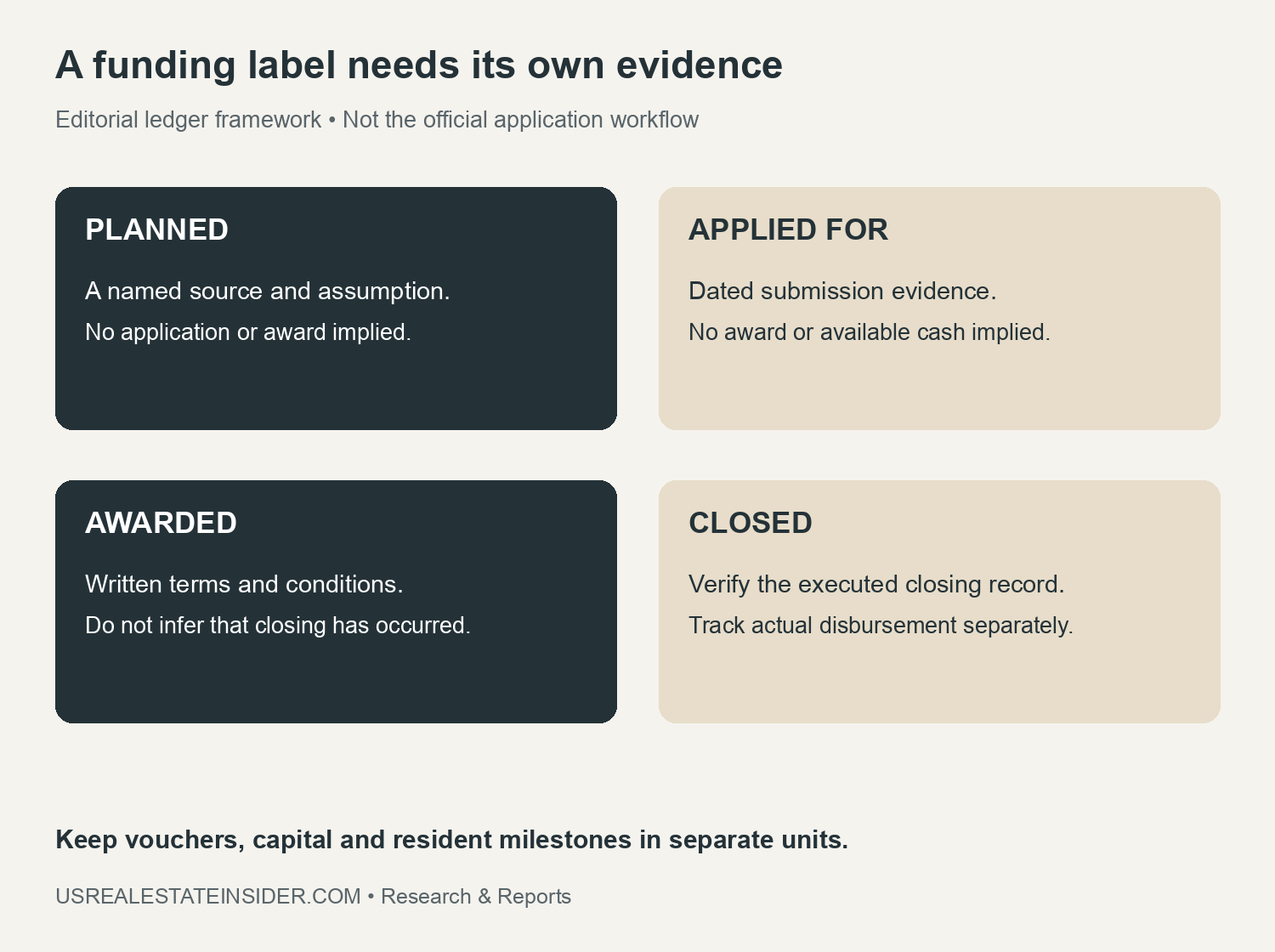
Suppose an invented source begins as planned. Changing its label to applied for should point to a submission record. A later written award belongs in a new dated entry, with its conditions retained. Do not overwrite the old assumption so completely that a colleague can no longer reconstruct what changed.
Similarly, an award announcement should not become a claim about cash received. Track the closing event and any disbursement evidence separately. This simple distinction is useful in public reporting as well as internal planning: each sentence can name the event it actually supports.
For a related evidence habit, see our guide to dated housing forecast assumptions. Our closing-pipeline example also distinguishes a milestone from a confirmed cash receipt. These are separate exercises, not additional funding terms.
Method, limitations and downloadable tools
Research checked November 23, 2026. We read the official notice and independently calculated the fictional unit split and cap comparison. The model contains no live offer, actual housing authority proposal, verified construction budget, resident record or eligibility decision. Its charts show arithmetic and assumed classifications, not survey findings.
The downloads preserve inputs, results, blank ledger fields and source locations. You can reproduce 40 + 60 = 100 and 40 × 350,000 = 14,000,000 without interpreting a chart. Keep the example values labeled fictional if you adapt them for teaching, and replace assumptions only with documented project-specific inputs.
- Fictional replacement and net-new unit counts (CSV)
- Reproducible general-cap comparison (CSV)
- Blank funding and resident-milestone ledger (CSV)
- Primary-source and claim register (CSV)
Suggested citation: US Real Estate Insider, “Massachusetts Public Housing Redevelopment: Count Replacement Units First,” November 23, 2026. Credit EOHLC for the notice and this report for the fictional ledger and arithmetic. This is an educational worksheet, not a funding determination or a promise to residents.