







VA loan cash to close with zero down can still be substantial. The down payment, funding fee and other closing charges affect different parts of the budget. In our fictional $300,000 purchase, financing the fee leaves $44,000 from a $50,000 cash balance. Putting 10% down and financing the fee leaves $14,000 instead. Neither result tells you which option suits your household.
Our analysis separates the new origination evidence from a budgeting exercise. Five charts, a fee decision tree and four downloadable CSVs make the assumptions visible. Use them to prepare lender questions and compare dated documents, rather than treat them as loan offers or eligibility decisions.
What the new zero-down VA loan data shows
Realtor.com’s November 10, 2026 research release reports that 75.7% of covered VA purchases had no down payment. A larger 86.1% had down payments below 10%, compared with 41.1% of covered conforming purchases. The first two VA groups overlap; they must not be added together.
The analysis uses Optimal Blue data for 30-year fixed-rate primary-residence purchase loans originated from October 2025 through September 2026. These are completed loans within that coverage. Their distribution does not measure your approval probability or establish the best down payment for a new applicant.
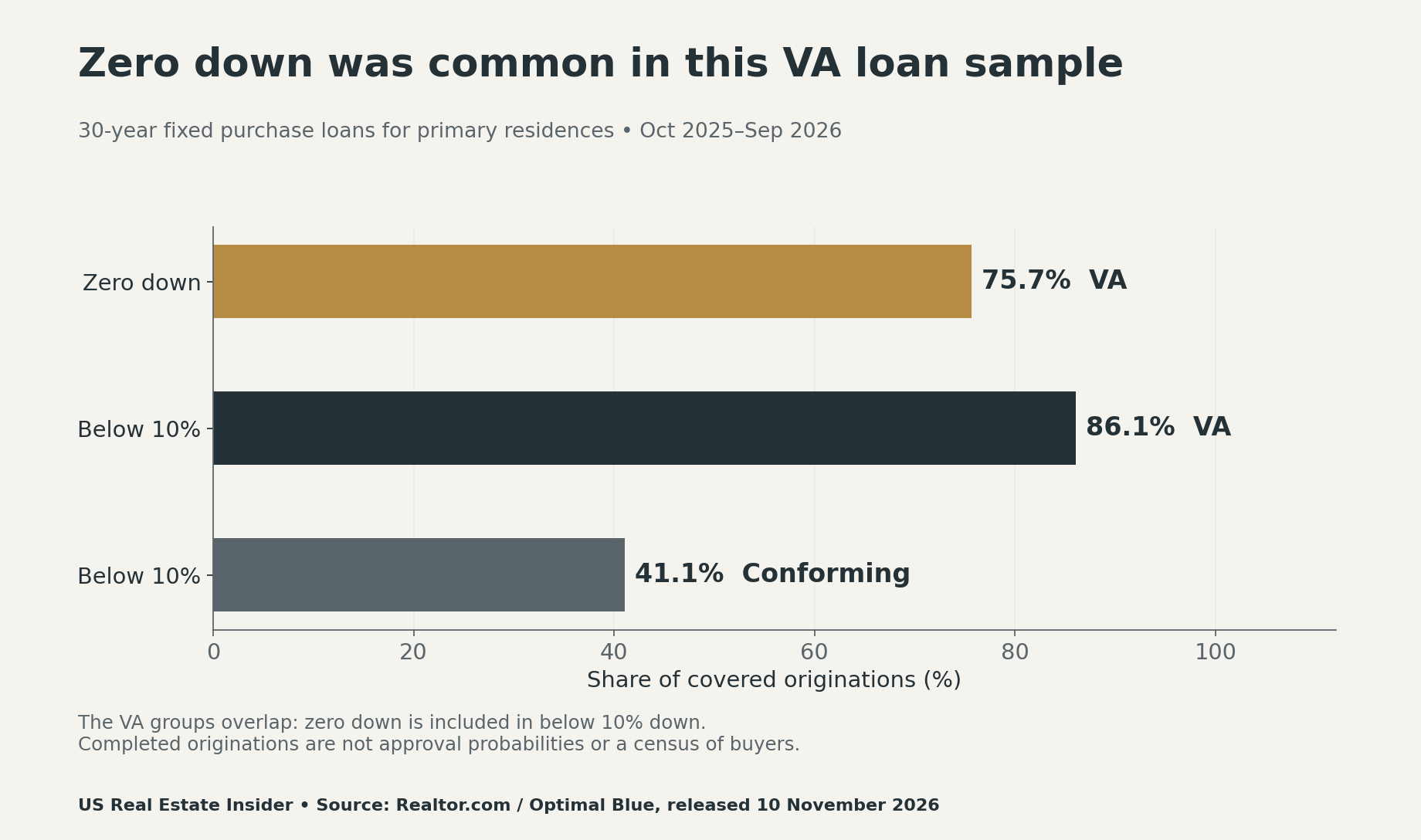
The release accompanies the Mission Zero campaign, which includes Veterans United Home Loans. That commercial context deserves visibility. Our calculations below do not reproduce the campaign’s buying-sooner claim or use historical average rates as current quotations.
Separate VA loan cash to close from the down payment
A useful ledger has three outputs: cash paid at closing, the financed loan balance, and accessible cash remaining afterward. One number cannot stand in for all three. A smaller closing payment can leave a larger balance, while a larger down payment can reduce the reserve available for an unexpected bill.
The CFPB’s Loan Estimate explainer distinguishes estimated cash to close from closing costs. The calculation takes account of the down payment, deposits, seller credits and other adjustments. Use the actual form to prevent a deposit already paid from being counted twice.
For our examples, all cash is measured immediately before closing, with no deposits or credits. We assume $6,000 of other closing charges. This is a deliberately chosen input, not an estimate of typical VA closing costs. Moving costs and immediate repairs would need their own deductions.
Confirm the applicable funding fee before comparing choices
VA’s official purchase-loan guidance lists first-use, non-exempt fee rates of 2.15% below 5% down, 1.5% at 5% or more, and 1.25% at 10% or more. Below 5%, subsequent use carries 3.3%; the other two tiers are unchanged. These rates took effect in April 2023, rather than being a new November 2026 policy.
The fee applies to the base loan amount. Eligible exemptions can remove it; confirm your status with VA and the lender. VA permits an applicable funding fee to be financed or paid upfront. For purchase loans, other closing charges cannot simply be rolled into the loan in the same way.
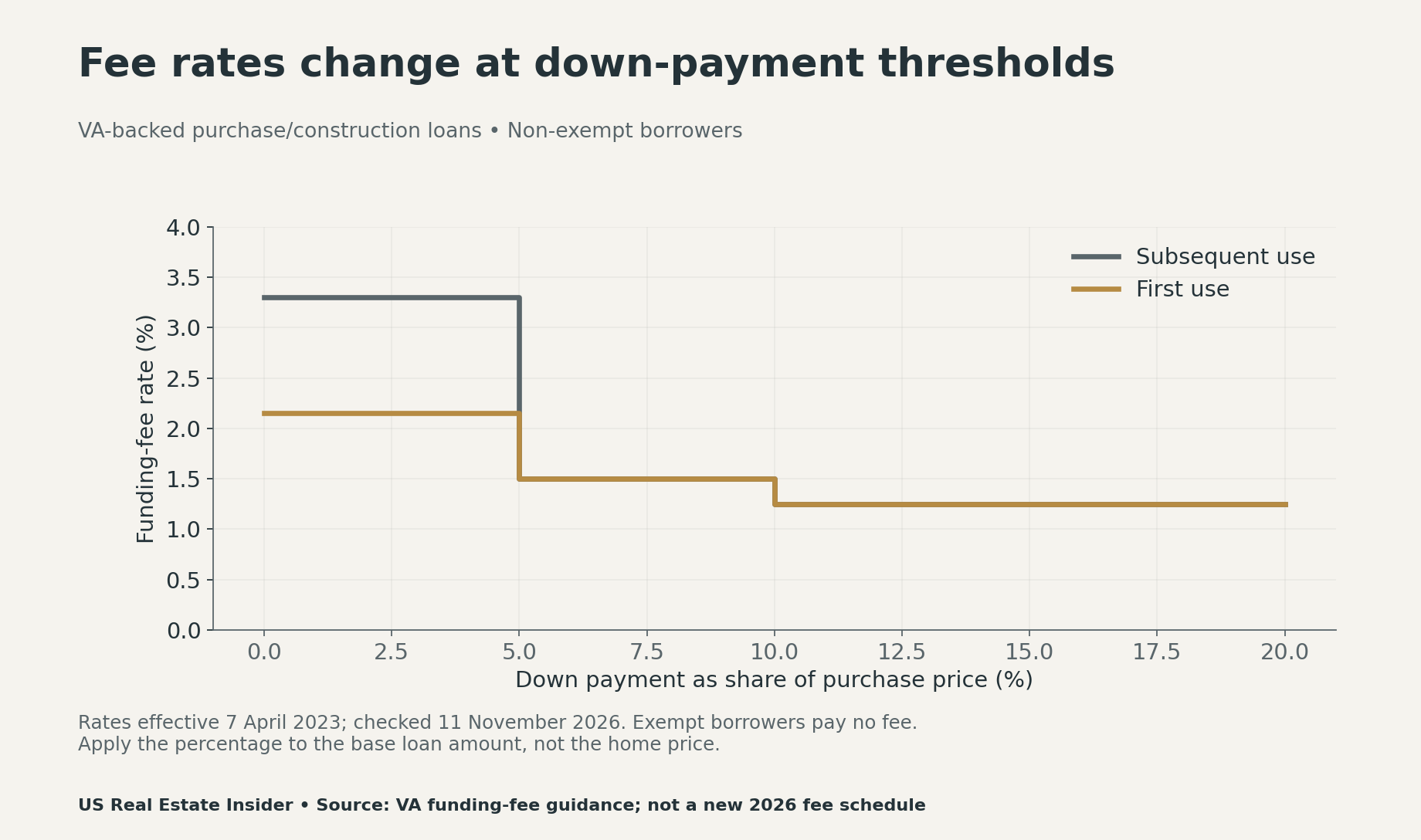
Our $300,000 illustration therefore starts with a $6,450 fee at zero down: $300,000 × 2.15%. At 10% down, the base loan is $270,000 and the fee is $3,375: $270,000 × 1.25%. Both cases assume non-exempt first use. A different status changes the worksheet before any payment comparison begins.
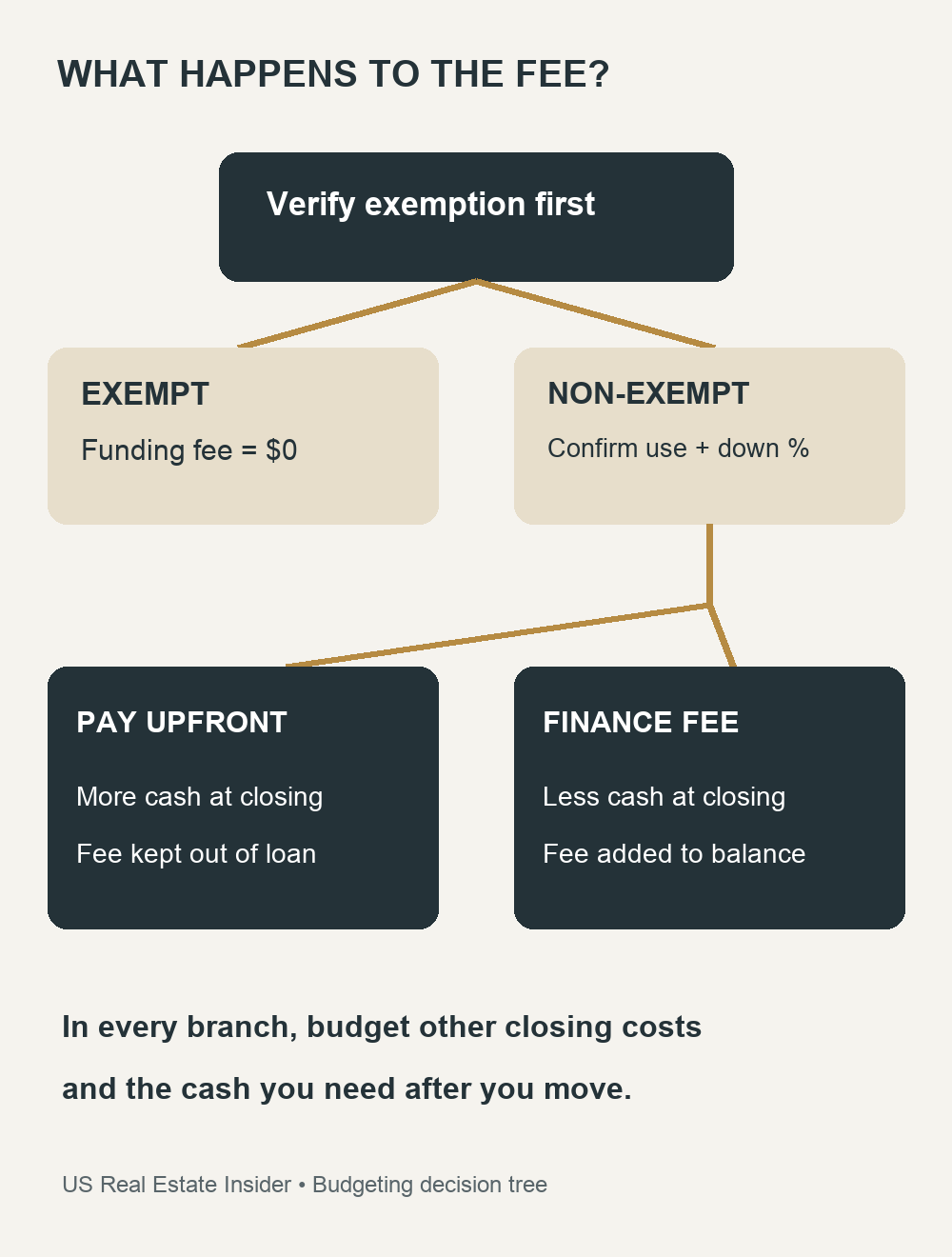
Compare VA loan cash to close across four fictional cases
Hold the home price, available cash and other closing-cost input fixed. Then vary just the down payment and how the funding fee is paid. This makes each trade-off easier to follow. It also avoids confusing a fee reduction with cash preserved by borrowing more.
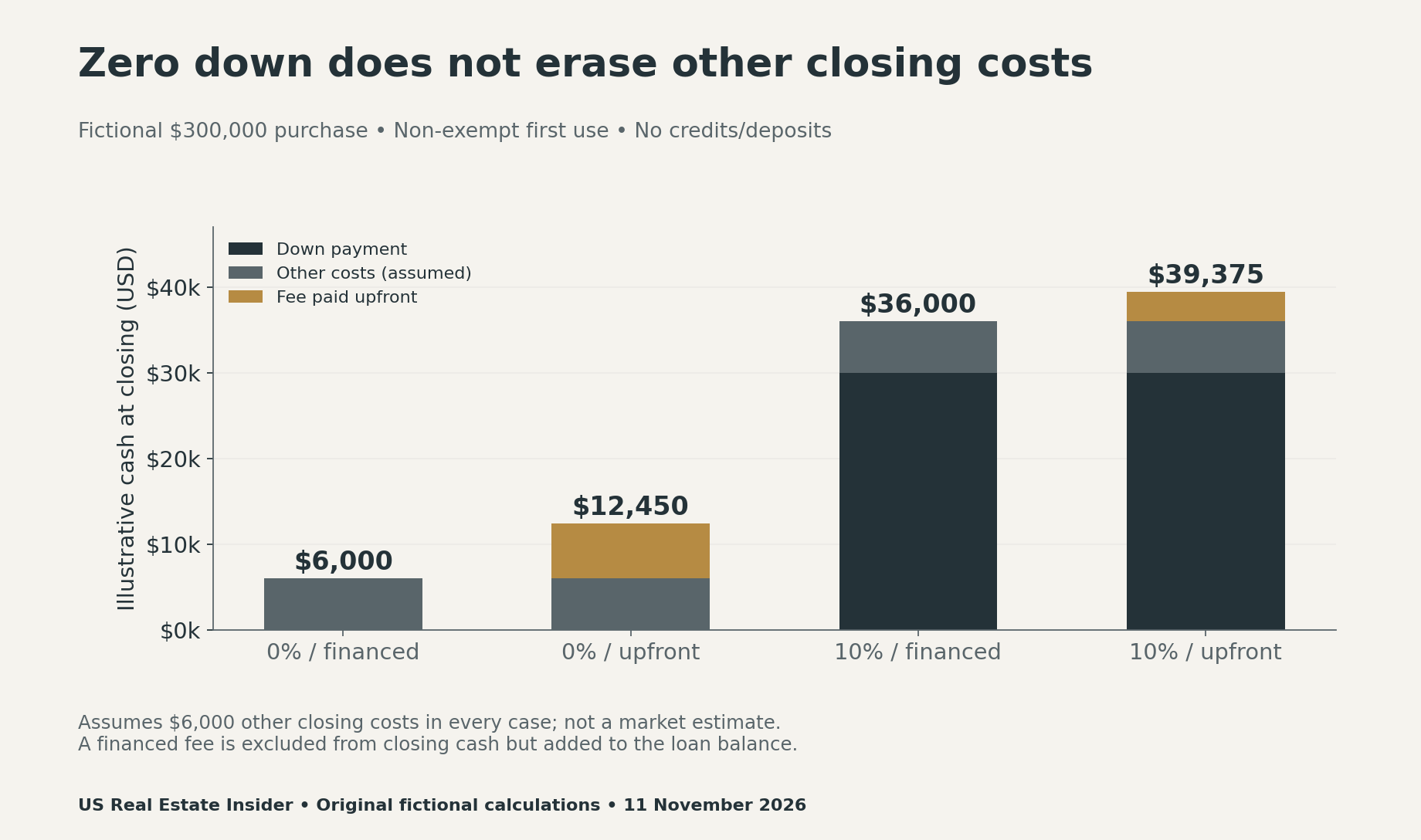
At zero down, paying the fee upfront uses an extra $6,450 of closing cash. At 10% down, that difference is $3,375. However, choosing 10% down also commits $30,000 to the purchase. A lower funding-fee rate does not mean a lower cash requirement.
Next, compare the resulting cash balance with your own needs. A household facing relocation, uncertain repair costs or irregular income may value liquidity differently from one with a separate reserve. These examples do not assign a monetary value to that flexibility or recommend borrowing more.
Test the reserve without treating it as a lending rule
We use $50,000 of pre-closing cash and a fictional $15,000 reserve target. The target is a budgeting input, not a VA minimum or a statement about adequate savings. Cash remaining equals starting cash minus the illustrated closing cash.
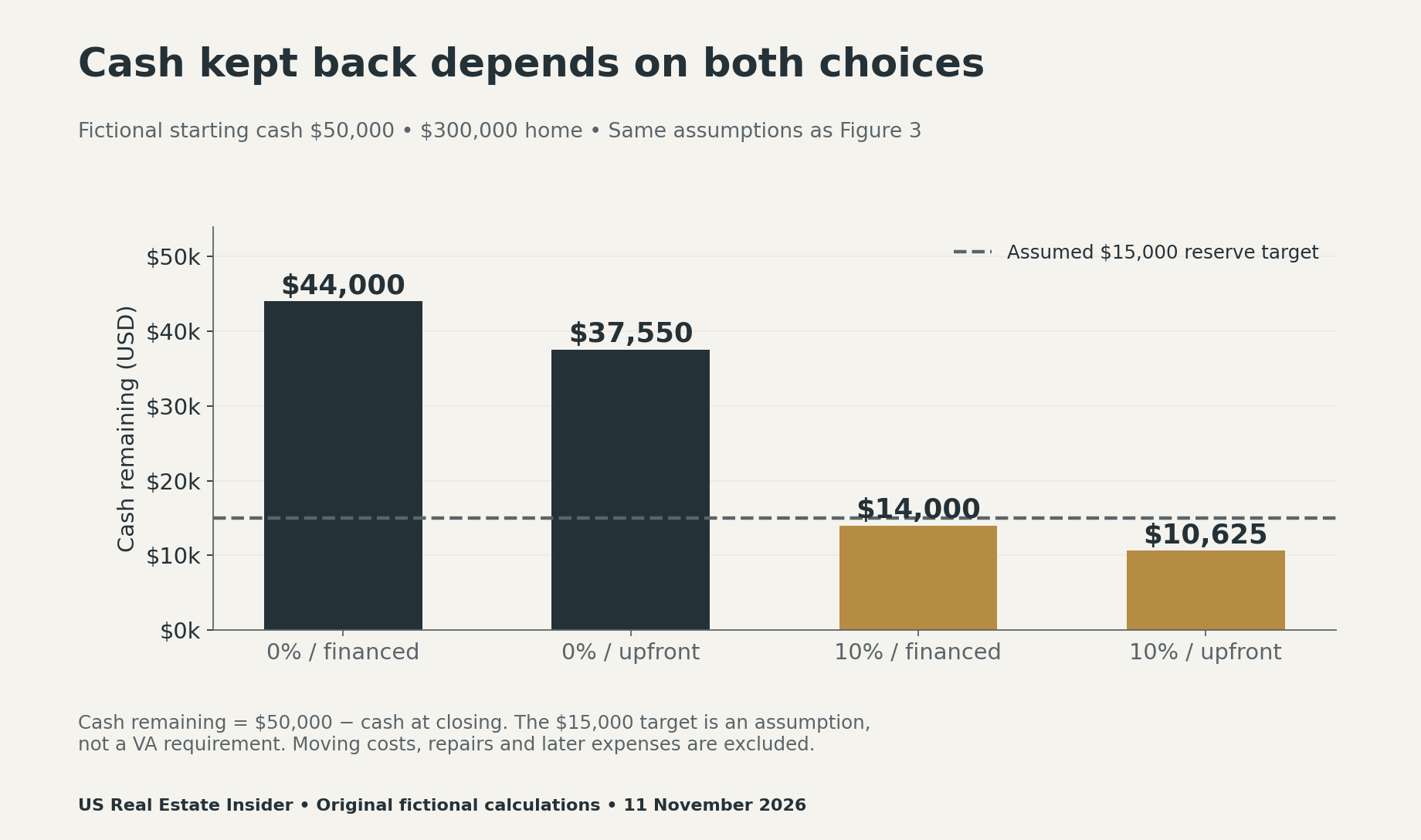
The zero-down, financed-fee case preserves $30,000 more cash than the 10%-down, financed-fee case. It also creates $33,075 more financed debt: the $30,000 base-loan difference plus the $3,075 funding-fee difference. Keeping both results visible is the point of the exercise.
Look at the monthly obligation as well as the cash buffer
For illustration only, we apply the same 6.5% fixed interest rate and 30-year term to all four cases. That assumption isolates balance changes. It is neither a current market rate nor a prediction of the rate a lender would offer.
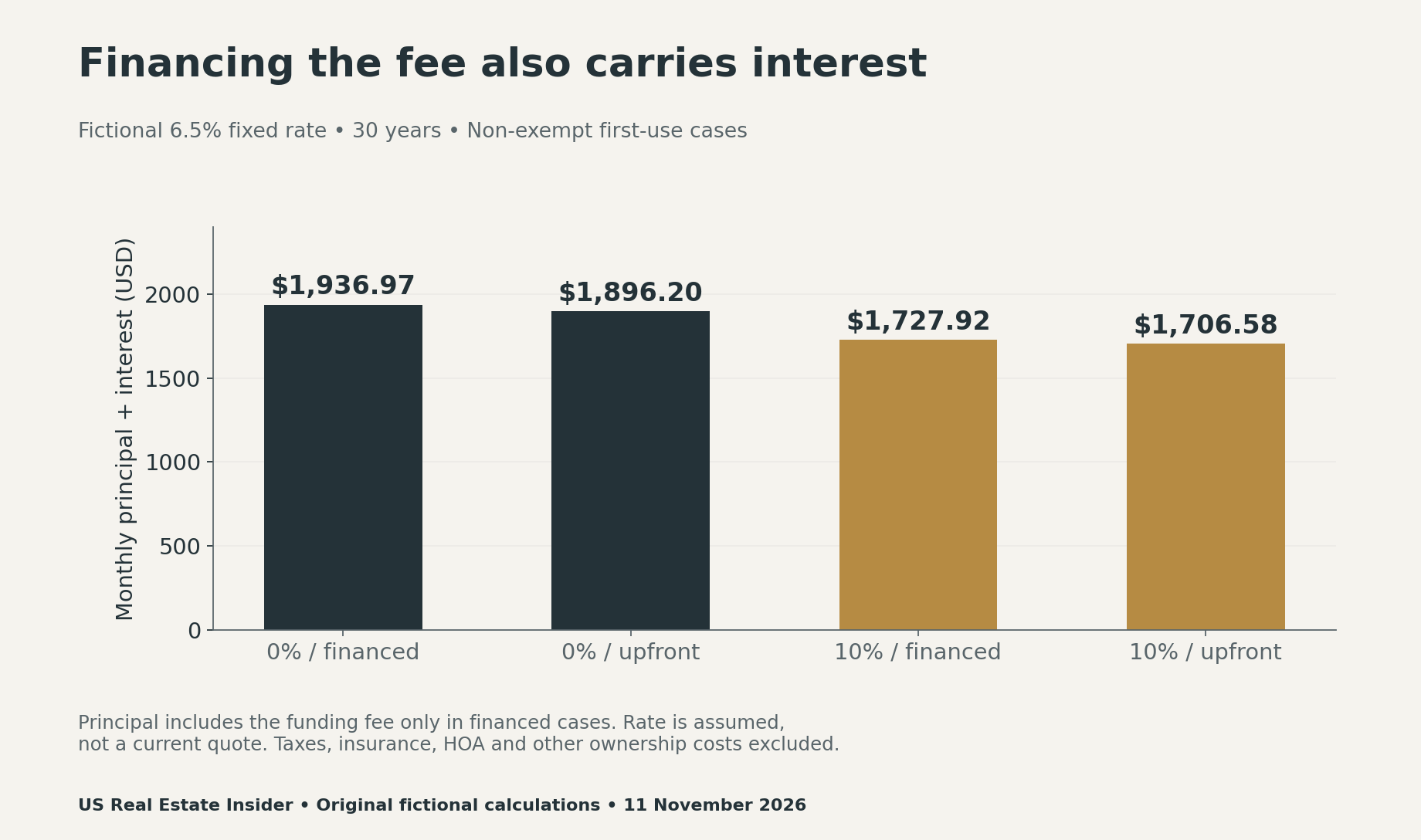
At zero down, financing the $6,450 fee adds about $40.77 a month in principal and interest under these assumptions. At 10% down, financing $3,375 adds about $21.33. Calculate from full-precision values before rounding; subtracting rounded chart labels can differ by a cent.
A realistic household budget must then add the property’s other bills and account for existing debts. If comparing lenders, keep the rate, points, fee treatment and estimate date together. A lower displayed principal-and-interest payment alone does not establish the cheapest full loan package.
Download the evidence and editable planning sheets
- Origination source-data register (CSV): three reported shares with coverage and overlapping-group caveats.
- Funding-fee examples (CSV): first/subsequent-use rates applied to a fictional $300,000 purchase.
- Cash and reserve scenarios (CSV): eight combinations, including an exemption flag, fee timing, balances and payment outputs.
- Blank closing-cash ledger (CSV): fields for actual amounts, source documents, dates and confirmation.
CSV files contain values, not automatically recalculating spreadsheet formulas. Keep the original examples, then enter your own verified inputs in a separate copy and reproduce the equations below. Do not treat toggling a text flag as confirmation of exemption or loan eligibility.
Reproduce the VA loan cash-to-close method
Base loan = purchase price − down payment. Applicable fee = base loan × fee rate, or zero when a verified exemption applies. Financed balance = base loan + the fee only when financed. In our no-credit, no-deposit examples, closing cash = down payment + assumed other costs + any fee paid upfront. Remaining cash = starting cash − closing cash.
Monthly principal and interest = L × r ÷ [1 − (1 + r)−n], using the financed balance L, monthly rate r = 0.065 ÷ 12, and n = 360. Calculations retain full precision; displayed dollars round to cents. The fee-example CSV also illustrates the 5% threshold, even though the main scenarios compare zero and 10% down.
The model excludes appreciation, resale, tax effects, investment returns on retained cash, refinancing, maintenance and changing household income. It does not establish eligibility, an appropriate reserve or a preferred loan. The covered origination sample cannot answer those individual questions.
For related checks, read our condo price-versus-HOA comparison and mortgage-term comparison guide. Bring a completed ledger and the lender’s current Loan Estimate to your next discussion. Ask what changes cash now, debt afterward and the full monthly budget.
Suggested citation: US Real Estate Insider, “VA Loan Cash to Close: Compare Zero Down and Cash Reserves,” November 11, 2026. Origination evidence: Realtor.com/Optimal Blue, October 2025–September 2026. Funding-fee context: VA guidance checked November 11. All purchase and reserve cases are original fictional calculations.