




Comparing net effective rent vs monthly rent requires two checks: the total cost over the lease and the cash due on each payment date. A free month can lower the average without lowering the rent charged in the other months. Our hypothetical example saves $600 before fees, yet still requires $1,800 in every paid month.
This guide turns a promotional headline into an auditable comparison. Use the calculator to enter two offers, separate refundable deposits from costs, and inspect the assumed monthly schedule. The examples are educational scenarios, not available apartments or recommendations.
What the latest concessions data measures
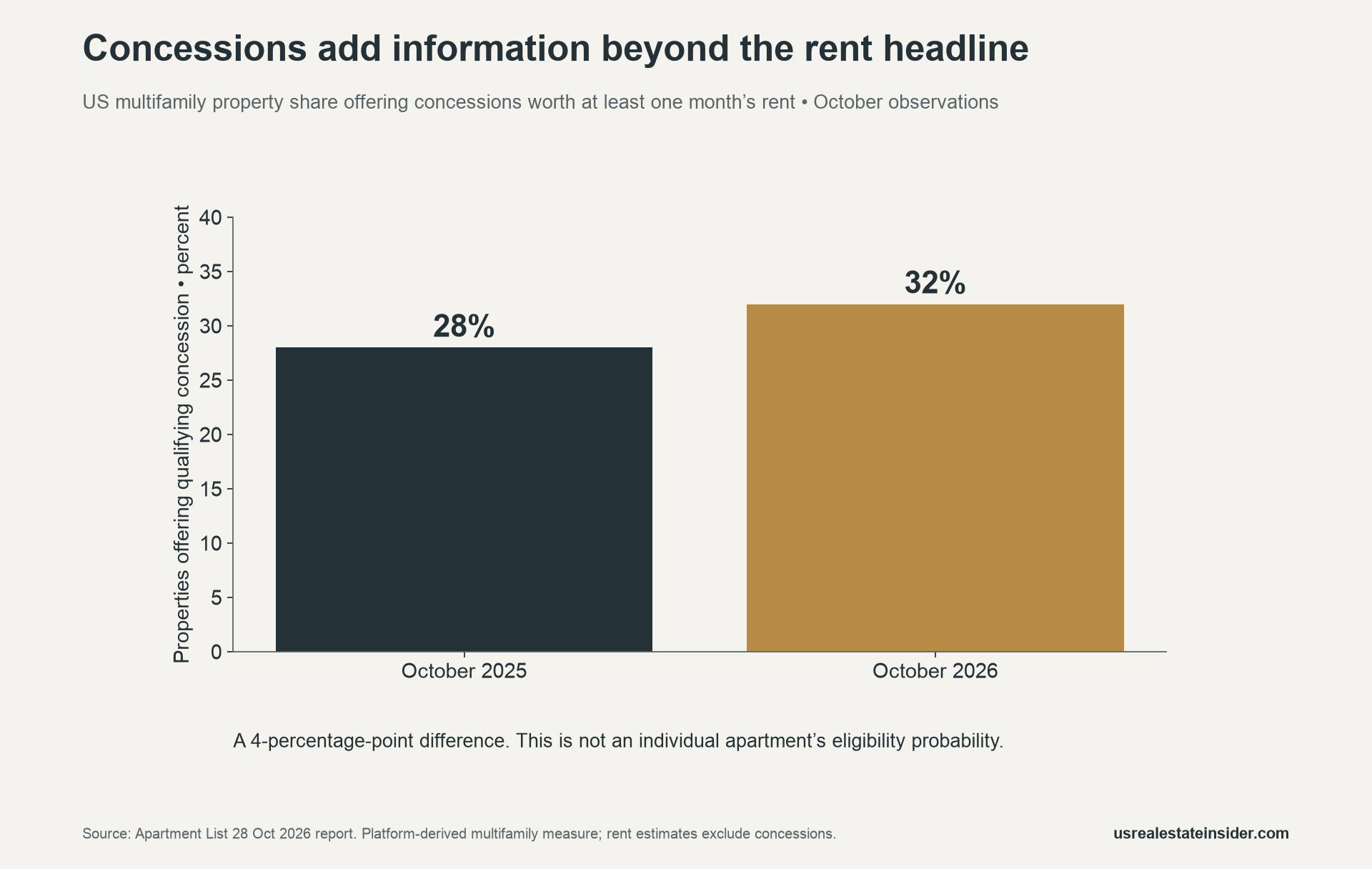
Apartment List’s 28 October 2026 national report, labelled its November update, reports October observations. It gives national median rent of $1,384, a 0.3% monthly decline and a 0.1% annual increase. Separately, 32% of multifamily properties offered concessions worth at least one month’s rent, compared with 28% a year earlier.
The rent estimates exclude concessions. Therefore, the rent headline and the promotional-offer share describe different measures. This platform-derived national property share does not establish that a particular listing has a discount or that a particular renter qualifies.
Define net effective rent vs monthly rent
Contractual monthly rent is the base amount specified in the agreement. Rent-only net effective rent spreads the total rent after credits across the lease term. Meanwhile, scheduled cash describes when rent, fees and other included payments actually leave your account.
Keep the labels explicit. In our tool, rent-only average = (months × base rent − rent credits) ÷ months. Average included cost additionally includes mandatory monthly fees and nonrefundable upfront charges. Neither average replaces the payment instructions in a signed lease.
Compare two equal-term offers
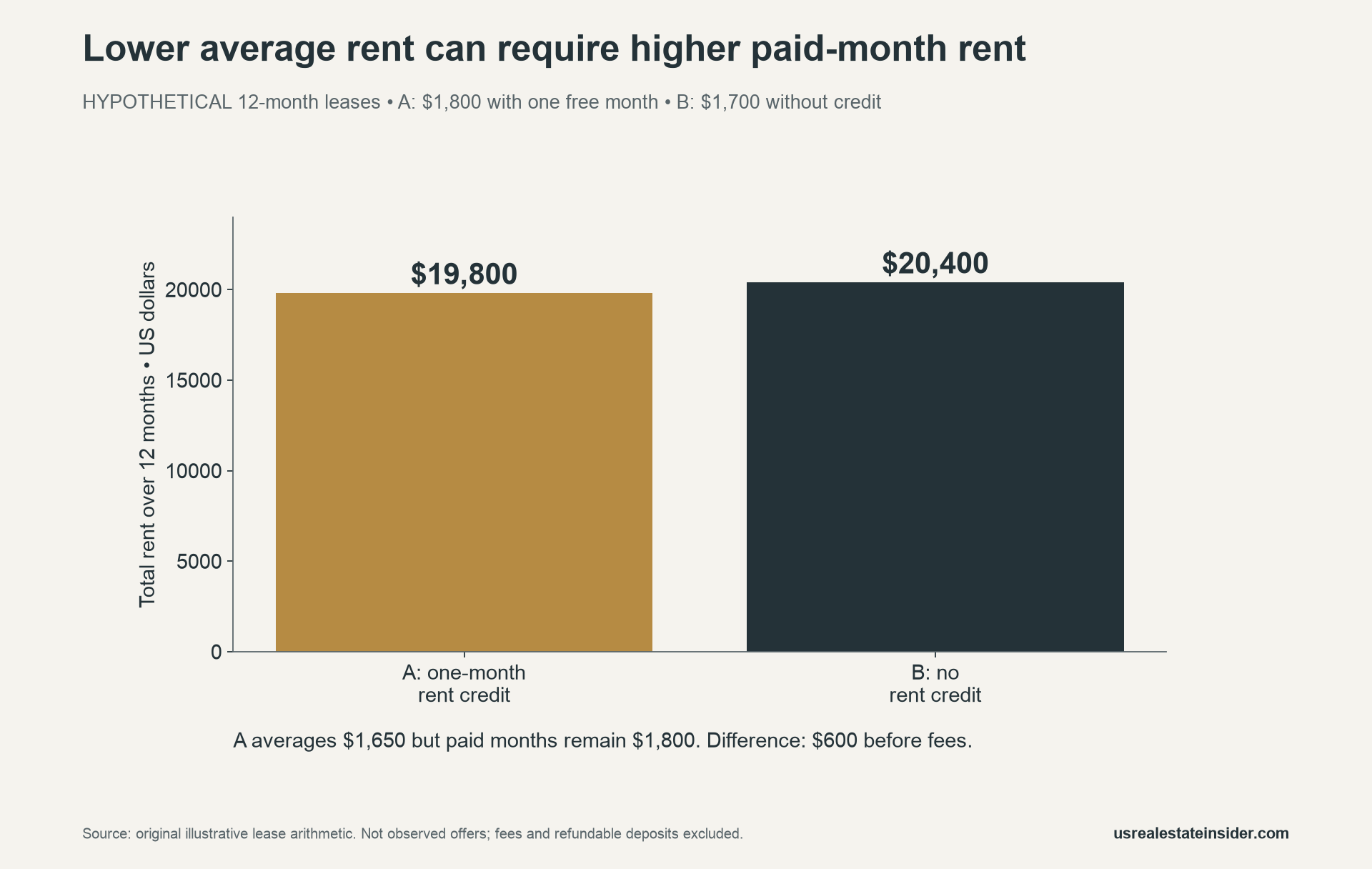
Consider two invented 12-month leases. Offer A charges $1,800 monthly with a $1,800 rent credit. Offer B charges $1,700 monthly without a credit. For now, assume no fees or other charges.
| Quantity | Hypothetical A | Hypothetical B |
|---|---|---|
| Monthly base rent | $1,800 | $1,700 |
| Scheduled base rent over 12 months | $21,600 | $20,400 |
| Total rent credit | −$1,800 | $0 |
| Total rent after credit | $19,800 | $20,400 |
| Rent-only monthly average | $1,650 | $1,700 |
A’s rent total is $600 lower. However, its paid-month rent is $100 higher. Those findings can both be true because one concerns an average and the other concerns a payment schedule.
Use the lease comparison calculator
Enter the same term for both offers. For each one, record base rent, a dollar rent credit, its start month, mandatory monthly fees, nonrefundable upfront charges and a refundable deposit. Enter zero only when you have confirmed that the charge is zero.
Compare lease totals and monthly cash
US-dollar educational scenarios, not listings. Credits reduce base rent from your selected month onward, capped at each month’s rent. Fees continue in credit months. Upfront charges and refundable deposits are paid in month1. Verify your actual contract schedule.
Refundable deposits are separate cash, excluded from included cost. Utilities, optional charges, moving costs, deposit deductions and early-exit repayments are outside this simplified model. No entries are transmitted or stored.
The tool applies credits from the selected month onward, capped at that month’s base rent. A larger credit continues into later months. It rejects credits exceeding the remaining scheduled rent. This is an explicit modelling convention; a written offer may allocate credits differently.
The first schedule row includes upfront charges and the refundable deposit. Deposit cash stays separate from the included cost total. If a real charge has another due date, rebuild the schedule from that agreement rather than treating this simplified timing assumption as fact.
Check whether fees reverse the result
For the example, total included cost equals term × (base rent + mandatory monthly fees) − rent credits + nonrefundable upfront charges. Refundable deposits are excluded from that cost equation and shown separately as cash required.
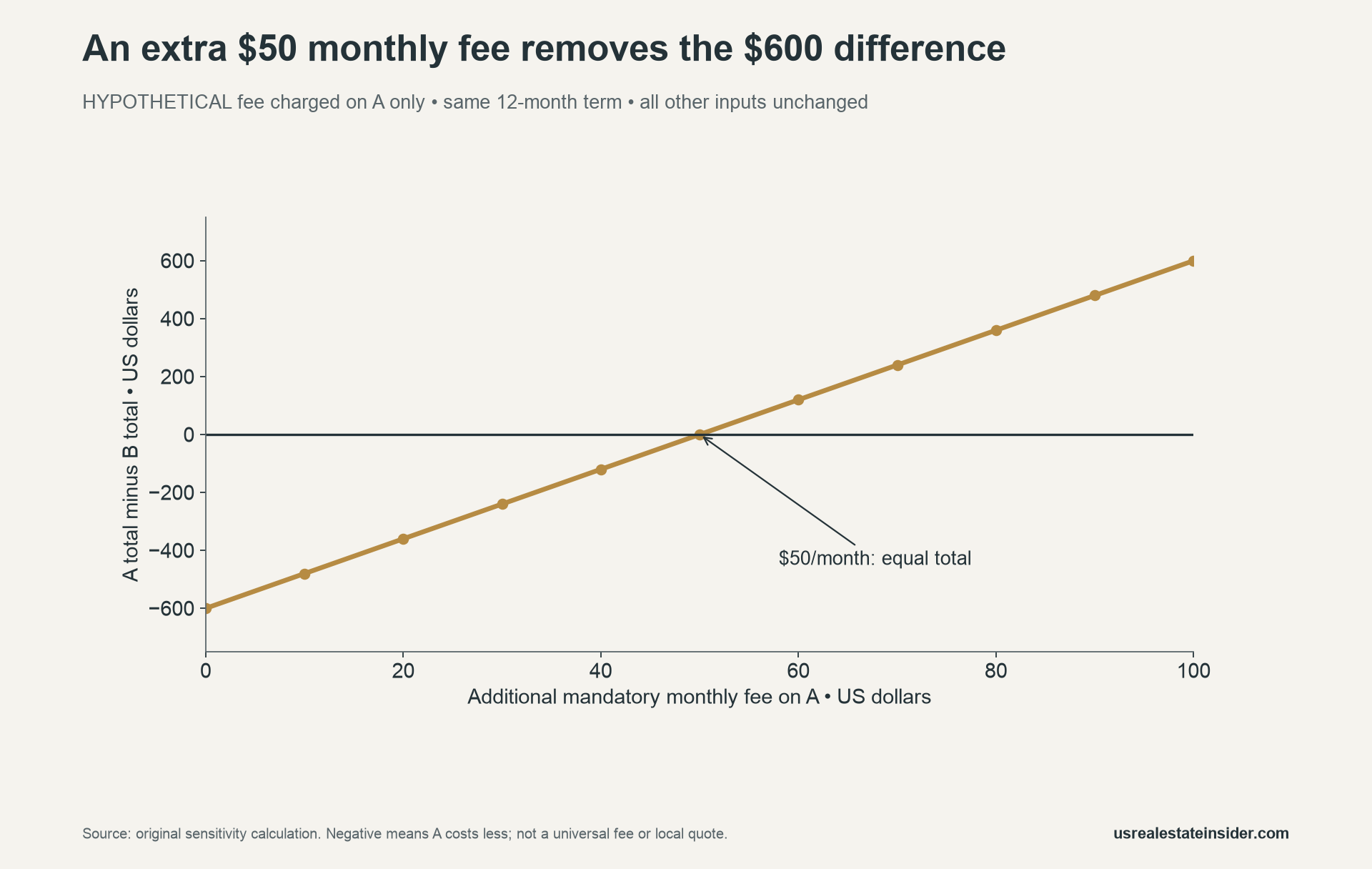
An extra $50 monthly fee on A adds $600 over 12 months. Consequently, A’s total becomes $20,400, equal to B before any other differences. Above that fee, A costs more in this narrowly defined comparison. The threshold is our arithmetic, not a claim about typical apartment fees.
Check each mandatory charge instead of comparing differently defined advertised averages. For example, ask whether parking, utilities, internet or amenity charges are mandatory, optional or separately metered. Add only verified amounts to a comparison, and retain unresolved charges as unknown.

Credit timing changes the cash-flow picture
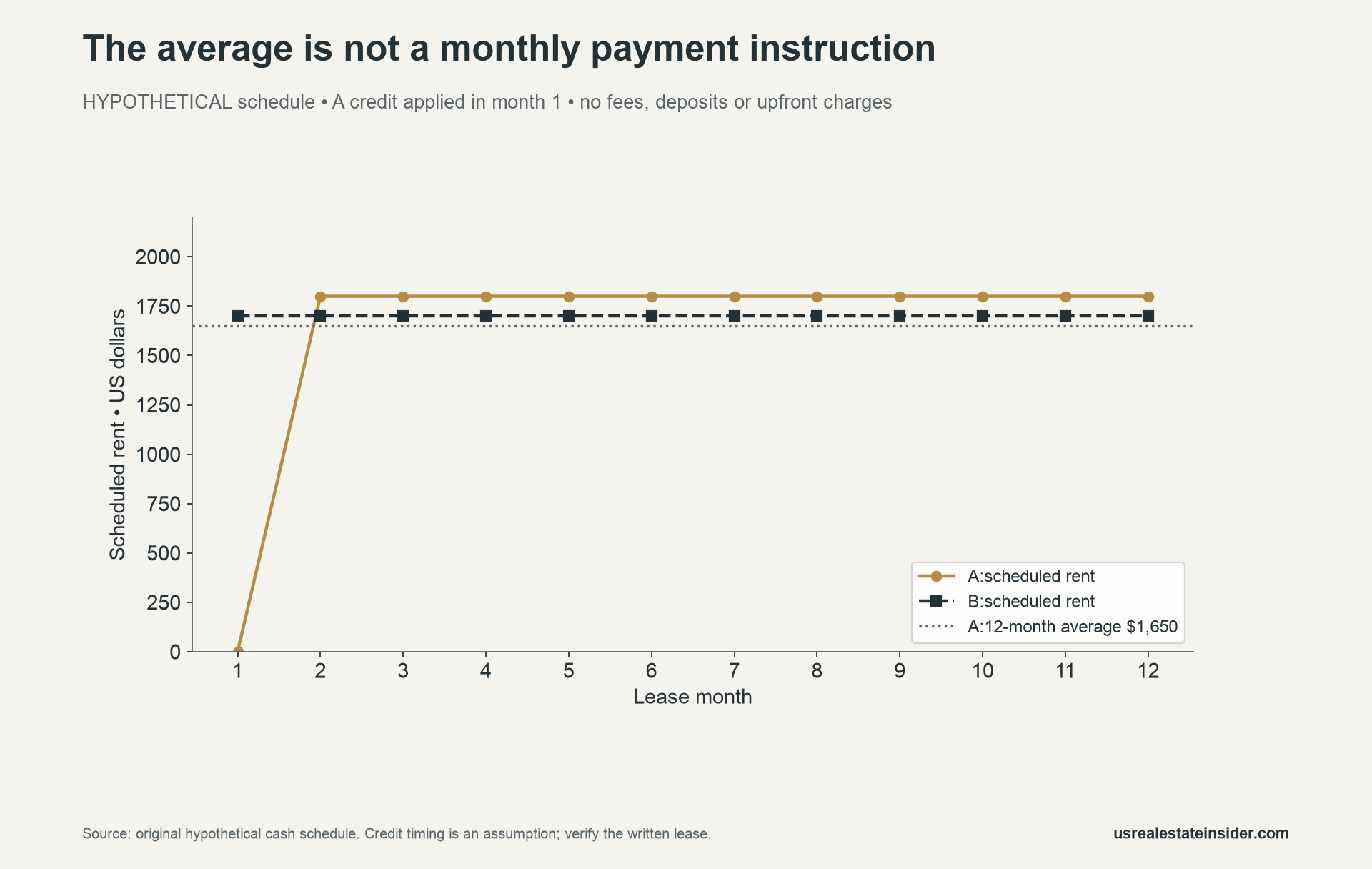
Suppose A’s credit applies in the first month. Its rent schedule begins at zero, followed by eleven $1,800 rent payments. If the same credit instead applies in month 12, the lease begins with eleven $1,800 payments and ends at zero. Both rent totals are $19,800.
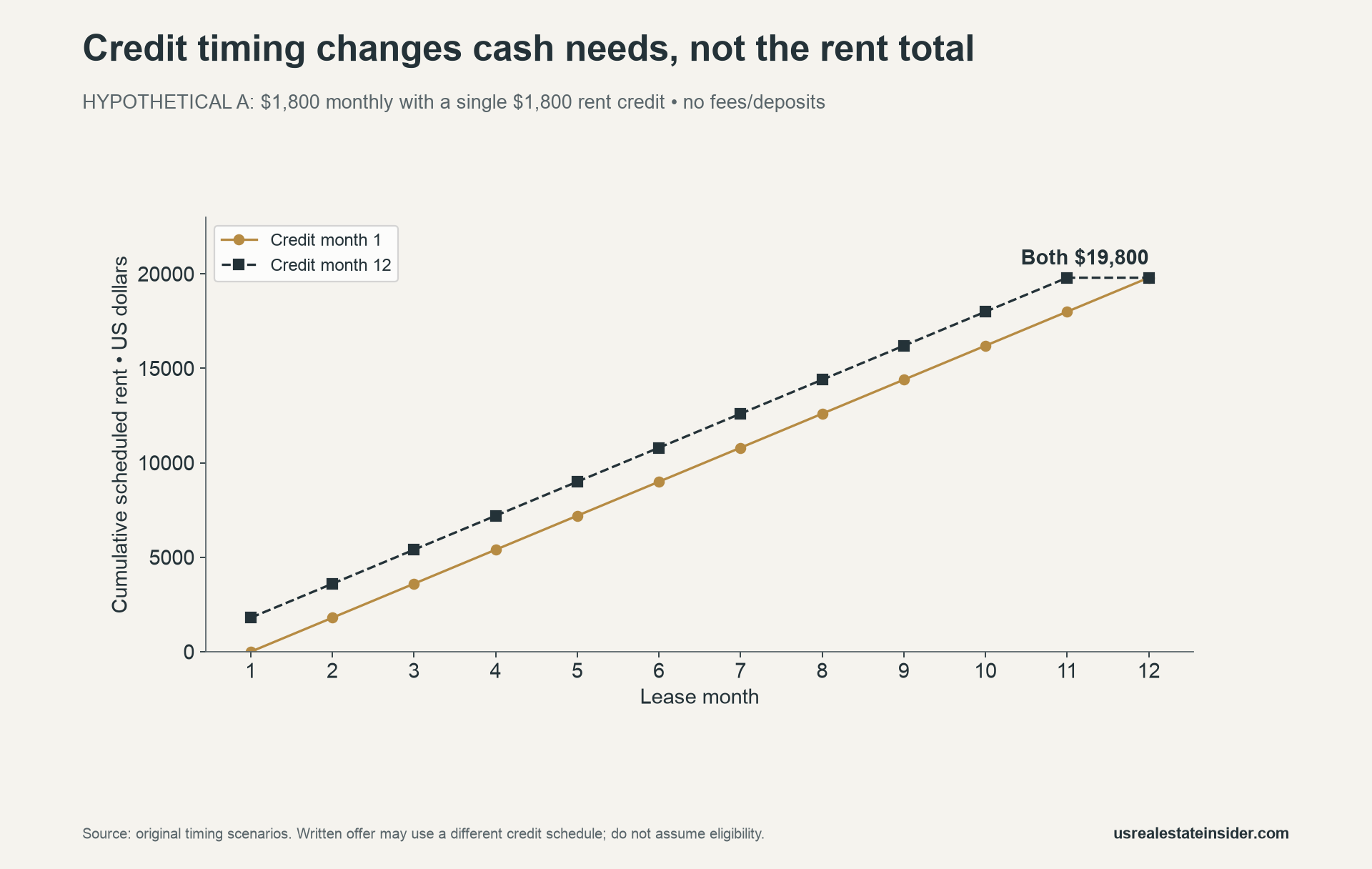
Thus, equal totals do not imply equal cash needs at move-in. A household should inspect the actual due dates alongside its own available cash. The calculator does not determine eligibility or whether a household can afford an agreement.
Verify the written offer before relying on a promotion
Ask which units, lease lengths and move-in dates qualify. Then confirm the credit’s dollar value, payment timing and documentation. A gift card or later reimbursement is not automatically equivalent to a credit against rent due at move-in.
Also, ask what the agreement says about renewal and early exit. Record any repayment condition as written, with the relevant clause and source date. Do not assume that every promotion repeats on renewal or that every contract requires repayment. Contract interpretation and local requirements need appropriate professional advice.
Download the transparent worksheets
The hypothetical payment schedules (CSV) retain each month’s credit, fees and cash amount. The separate fee sensitivity calculation (CSV) varies only A’s extra monthly fee. Every row is labelled as a scenario rather than a market quote.
Use the blank lease comparison worksheet (CSV) for written offers, conditions and unresolved questions. Our executed validation cases (CSV) cover nine arithmetic and boundary checks, including deposits, credit timing and invalid inputs. These checks validate calculations, not a landlord’s statements.
Method and limits
US Real Estate Insider used decimal arithmetic for the retained examples and checked that monthly schedules sum to the formula totals. The browser calculator rounds monetary inputs to cents. It excludes optional costs, moving expenses, uncertain deposit deductions and early-exit repayment scenarios.
National concessions data cannot establish local availability, property condition or a renter’s legal entitlement. For separate market context, see our Virginia apartment demand and supply analysis. Our mortgage payment scenario likewise separates assumptions from observed market statistics; it is not a complete rent-versus-buy model.
Suggested citation: US Real Estate Insider, “Net Effective Rent vs Monthly Rent,” published 2 November 2026. Cite Apartment List’s 28 October release for national observations and this article for the original hypothetical lease comparison and worksheets.


