



HELOC vs emergency fund comparisons should start with access, not a combined total. Cash is already available; an undrawn home-equity line is conditional borrowing capacity. A renovation contingency becomes clearer when those two resources stay on separate lines, with their own timing, costs and evidence.
Our original example uses $15,000 of cash, a $40,000 undrawn line and $25,000 of urgent obligations. It tests the arithmetic when a new draw succeeds and when no further borrowing is available. The exercise assigns no probability to either outcome and makes no recommendation to borrow.
The fresh HELOC figures describe debt and limits
The New York Fed’s 10 November 2026 release reports third-quarter HELOC balances up $23 billion to $481 billion at September-end. Credit limits rose $31 billion. The balance increase was the largest since 2005, according to the release.
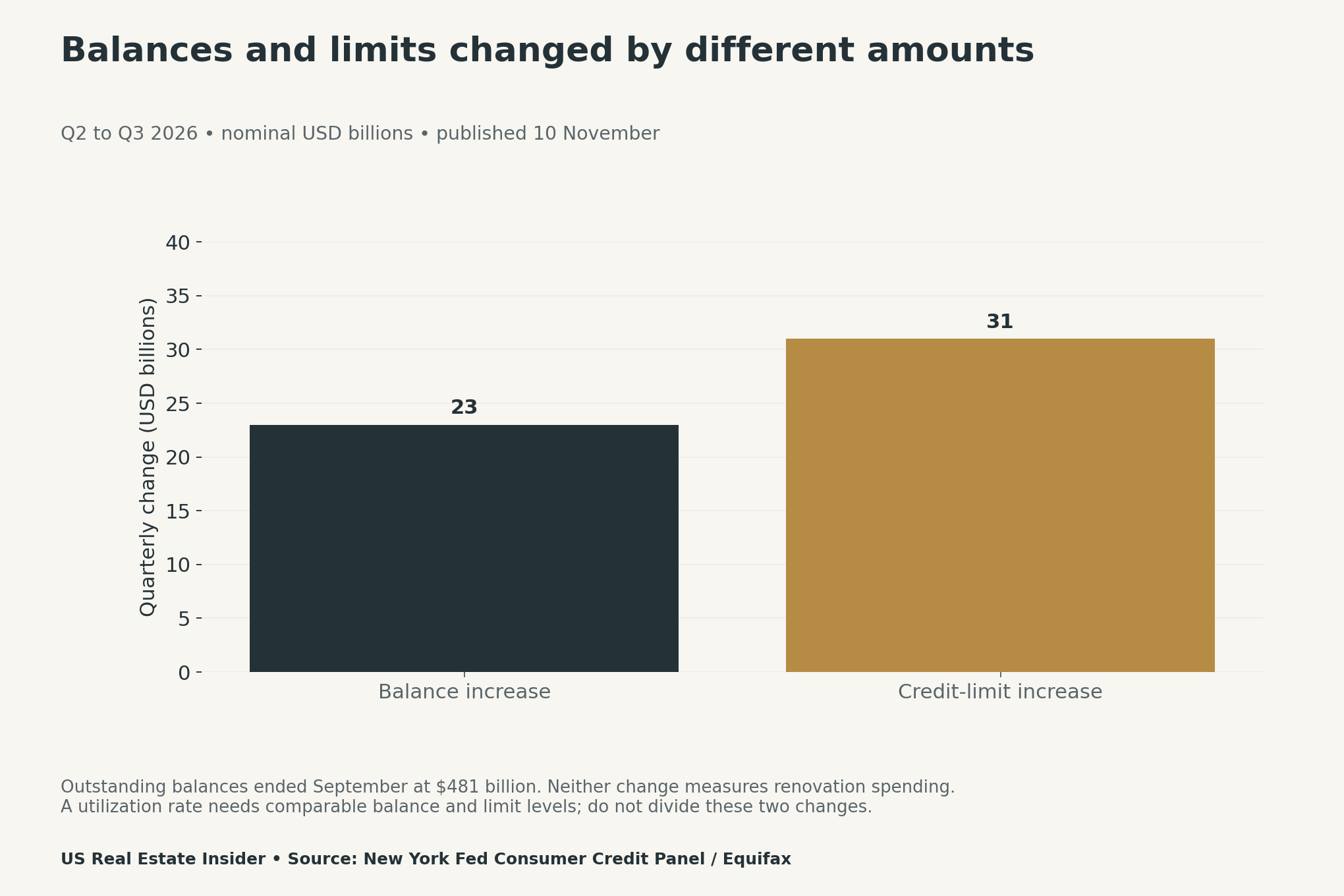
Those figures come from the Consumer Credit Panel, based on anonymized Equifax credit-report data. They do not establish $23 billion of renovation spending, count new borrowers or show why a particular household used credit. We retain the reference period and stock-versus-change distinction in the source file.
Also, dividing the balance change by the limit change would not produce a national utilization rate. The numerator and denominator would both be movements, rather than comparable outstanding levels. Our chart keeps them separate and makes no such calculation.
HELOC vs emergency fund: conditional access matters
The CFPB’s HELOC explanation, reviewed 28 August 2026, describes circumstances in which further draws may be restricted, including significant property-value declines or a worsened financial situation affecting repayment. It also explains that borrowing uses the home as collateral.
After the draw period, payments can increase as repayment begins. Variable rates and fees can also affect the obligation. These are product-risk questions to check against the actual agreement, not evidence that a specific reader’s line will be frozen.
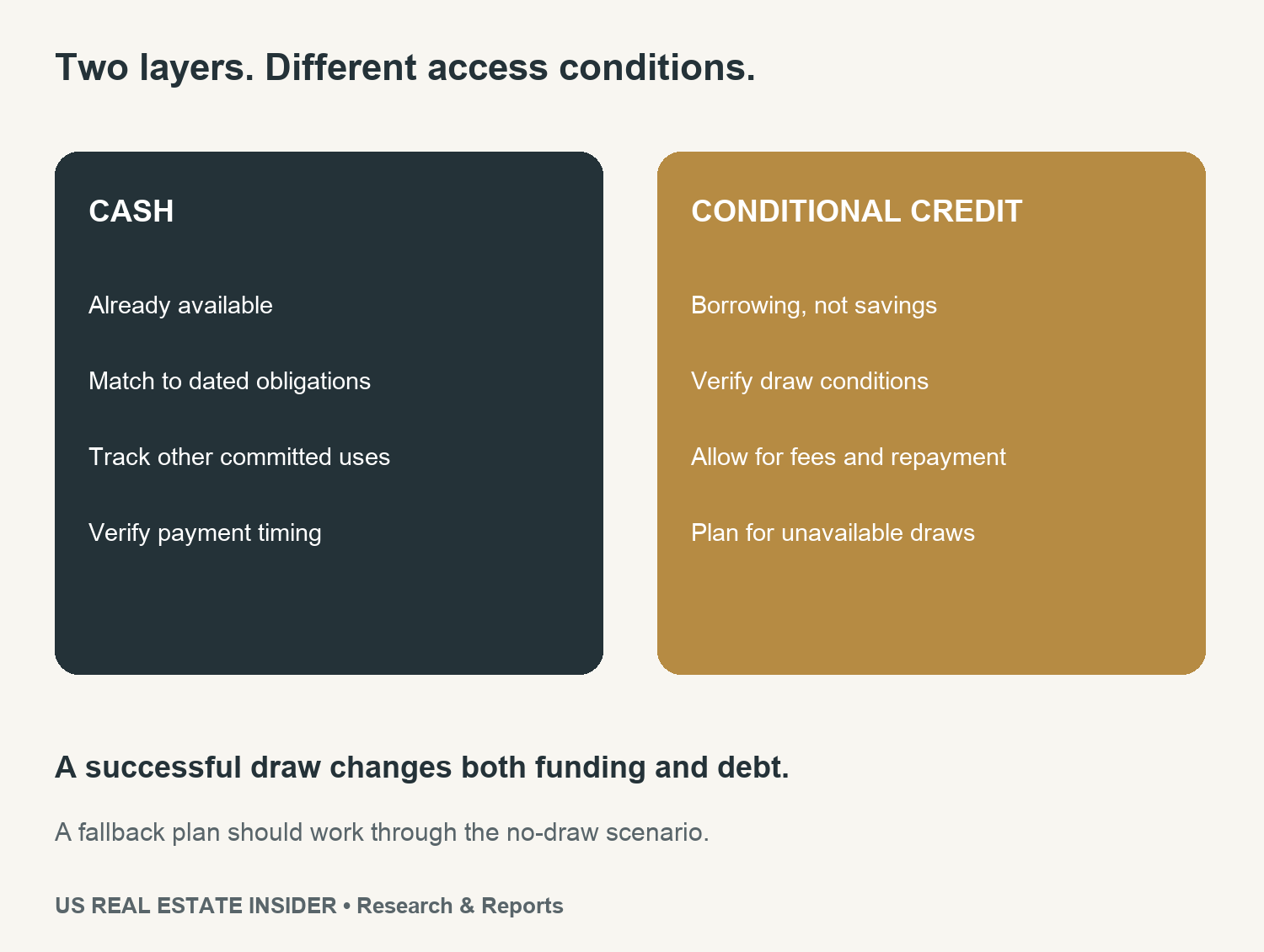
A line’s stated limit is therefore a different planning input from cash held for emergencies. Keep a dated record of what is available, what has already been drawn and what conditions remain. If a field is uncertain, keep it unknown until the agreement or lender supplies evidence.
A fictional renovation example
| Item | Fictional amount | Planning treatment |
|---|---|---|
| Starting cash | $15,000 | Cash layer; check other commitments |
| Undrawn HELOC capacity | $40,000 | Conditional credit layer |
| Urgent obligations | $25,000 | Dated payments still to fund |
| Cash-only shortfall | $10,000 | Obligations minus starting cash |
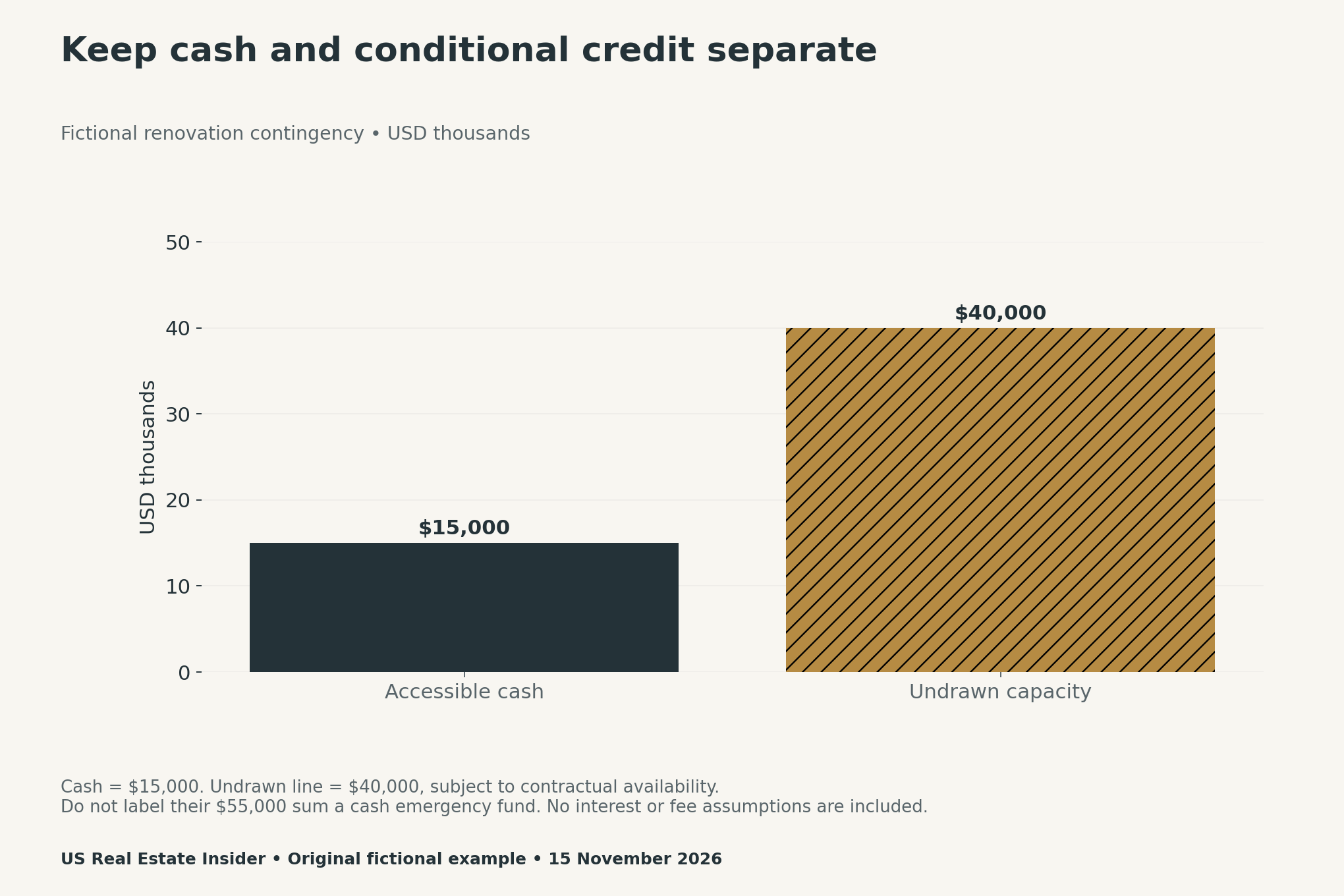
Against $25,000 of urgent obligations, the cash-only gap is $25,000 minus $15,000, or $10,000. The $40,000 undrawn figure does not erase that gap unless borrowing is available, a draw is completed and the proceeds arrive in time.
Even this simplified cash figure needs a boundary. If part of the $15,000 already covers ordinary household bills, less remains for the project. Our example assumes the whole amount is available for the listed obligations; your own ledger should disclose any competing commitments.
Test a no-draw scenario without predicting a freeze
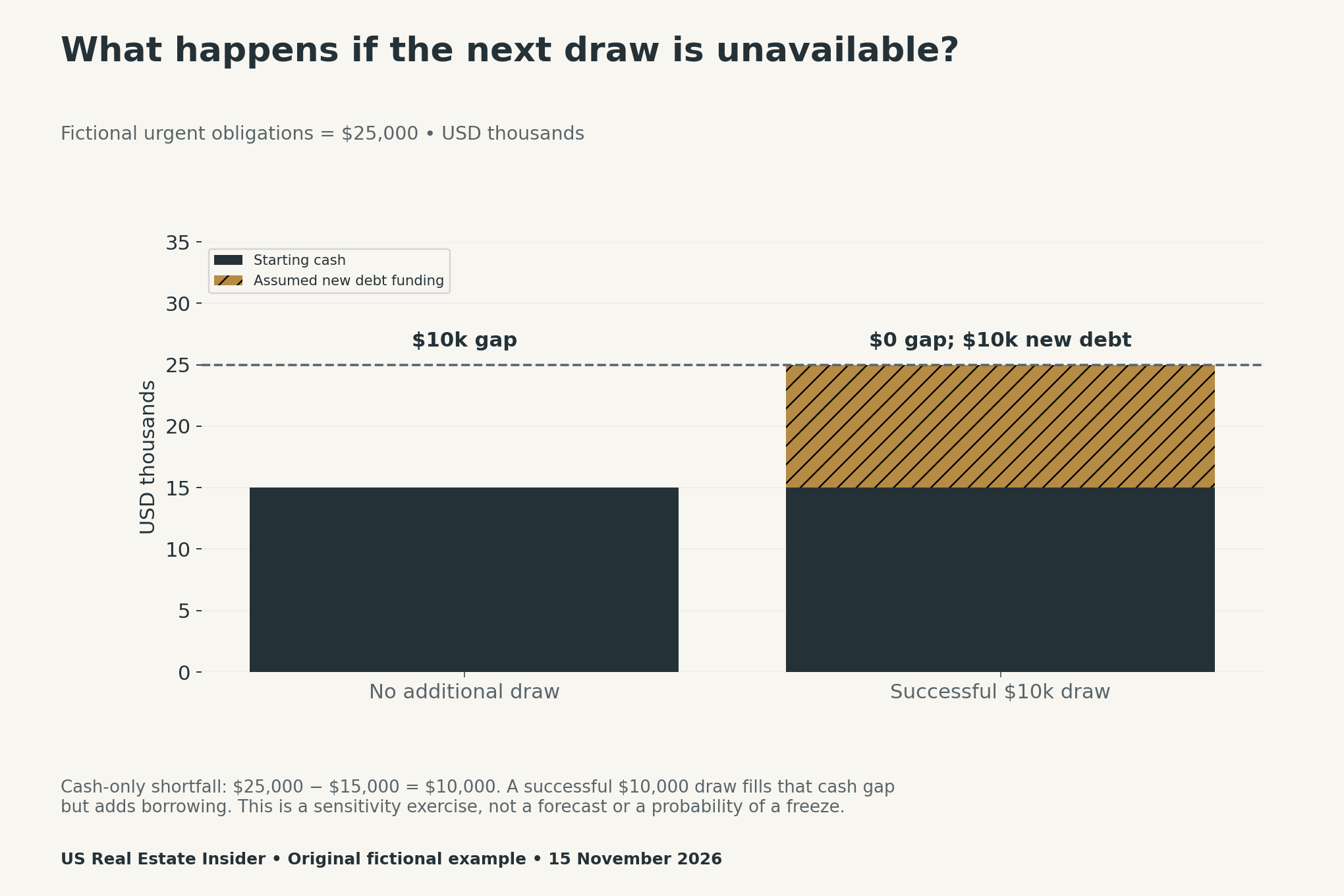
The second scenario assumes a $10,000 draw succeeds. That creates enough funding for the stated $25,000 obligation, before any fees or interest. However, the household now has a new debt obligation. Funding a bill and reducing financial risk are separate questions.
The first scenario assumes no further draw is available. It does not say that a freeze is likely, nor that a lender has acted. Its purpose is to reveal the cash shortfall before a project commitment relies on a source that might not be accessible.
A fallback discussion might examine the timing and scope of discretionary work, documented invoice dates and other verified resources. It should not assume a contractor will change terms, that an obligation can be ignored or that refinancing will be approved. Record what is actually agreed.
Review the contract questions before counting capacity
| Topic | Question to verify | Evidence |
|---|---|---|
| Availability | Draw period expiry and any current draw restrictions | Agreement and dated lender confirmation |
| Cost | Variable rate, adjustment terms, fees and minimum draws | Agreement and current statement |
| Repayment | Payment during draw period and repayment schedule afterward | Contract schedule and lender explanation |
| Collateral | Home secures the borrowing; missed payment consequences | Agreement and qualified advice |
| Fallback | Cash needs if additional borrowing is unavailable | Dated invoice and household cash plan |
The useful answer is specific and dated. For example, “draw period ends on this date under this agreement” is stronger evidence than a general description of typical HELOCs. Likewise, record what a quoted payment includes and whether it changes after a new draw or a rate adjustment.
Keep sensitive loan documents in your own secure records. The public downloads are blank or fictional and request no account numbers, identity documents or private applicant information. You can use short references in the worksheet rather than copying full financial documents into it.
Build the cash-and-credit ledger
The blank project sheet gives cash, already-drawn debt, undrawn capacity and committed invoices separate columns. It also records dates, access conditions and unknowns. This keeps an existing liability from silently being treated as a fresh source of funding.
Update the ledger when something material changes: a confirmed invoice, a completed draw, a new statement or a documented restriction. Retain earlier versions if you want to explain how the plan changed. Do not treat an old available-credit display as a guarantee of future access.
Download the source-linked tools
- Q3 HELOC source measures, units and dates (CSV)
- Fictional renovation liquidity scenarios (CSV)
- Blank project cash-and-credit ledger (CSV)
- HELOC contract-question register (CSV)
For another financing distinction, see our mortgage availability and borrower-fit guide. Our housing-budget reconciliation explains why each household expense needs its own evidence.
Methodology and limits
We verified the New York Fed release and the CFPB guidance on 15 November 2026. The aggregate chart reproduces selected published measures. The two scenario charts, table and CSV use identical invented inputs; no borrower records, lender offers or project invoices were sampled.
The simplified examples exclude interest, fees, taxes and future repayment calculations. They test access to funding, not the suitability or affordability of a loan. Because the home secures borrowing, inability to repay can risk losing it. Obtain qualified guidance for an individual financing decision.


