



Shelter CPI vs housing costs is a measurement question before it is a budgeting question. October’s national shelter index rose 0.3%, but that does not say how much your rent renewal, mortgage payment or total housing bills changed. This guide shows how to choose the right evidence and reconcile a separate household budget.
Our original worksheet keeps national statistics, market listings and personal outgoings in different columns. A fictional example then turns five dated expense lines into a transparent dollar change. You can replace those invented inputs with your own evidence without pretending to recreate the Consumer Price Index.
Shelter CPI vs housing costs: the October reading
The BLS release published on 10 November 2026 covers October. Seasonally adjusted monthly changes were 0.3% for shelter, 0.3% for owners’ equivalent rent, 0.2% for rent of primary residence and 0.6% for lodging away from home. Shelter had risen 0.4% in September.
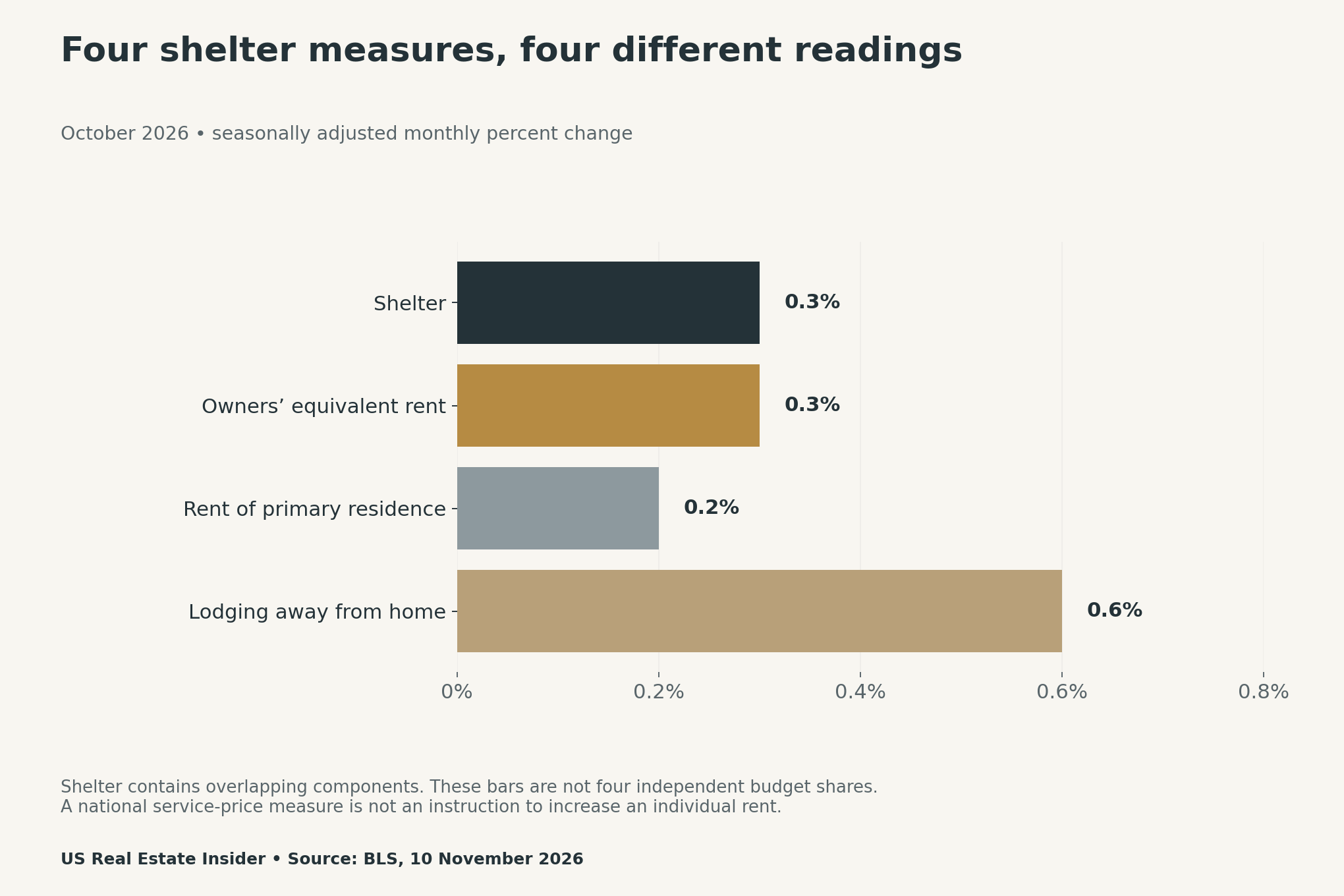
Keep each number attached to its period and unit. A monthly percentage change is different from a dollar payment, an annual rate or an asking rent. The source also has unavailable year-over-year cells; our comparison leaves those gaps unfilled rather than inventing estimates.
What owners’ equivalent rent actually represents
The BLS rent and rental-equivalence factsheet explains that shelter measures a housing service. For owners, rental equivalence represents the implicit rent of an unfurnished home without utilities. The house as a purchased investment is a different concept.
Mortgage interest, property taxes and improvement costs are outside that owned-housing consumption measure. The survey observes rental units at six-month intervals. Consequently, an owner’s cash outgoings and the published OER reading answer different questions, even when both are relevant to a housing discussion.
For example, a mortgage statement can tell you what you owe under that loan. It cannot, by itself, establish the national price of housing services. Similarly, an OER movement does not tell you whether your insurance renewal arrived or whether your property-tax payment is due this month.
Choose evidence for the question you need answered
| Question | Useful evidence | Comparison check |
|---|---|---|
| National housing-service inflation | BLS shelter CPI | Published period and adjustment |
| Available rentals now | Dated comparable local listings | Address, asking rent, concessions and availability |
| Renewal payment | Actual lease and renewal notice | Same unit, services and effective date |
| Owner cash budget | Actual bills, statements and reserve plan | Same period; distinguish actual payment from allocation |
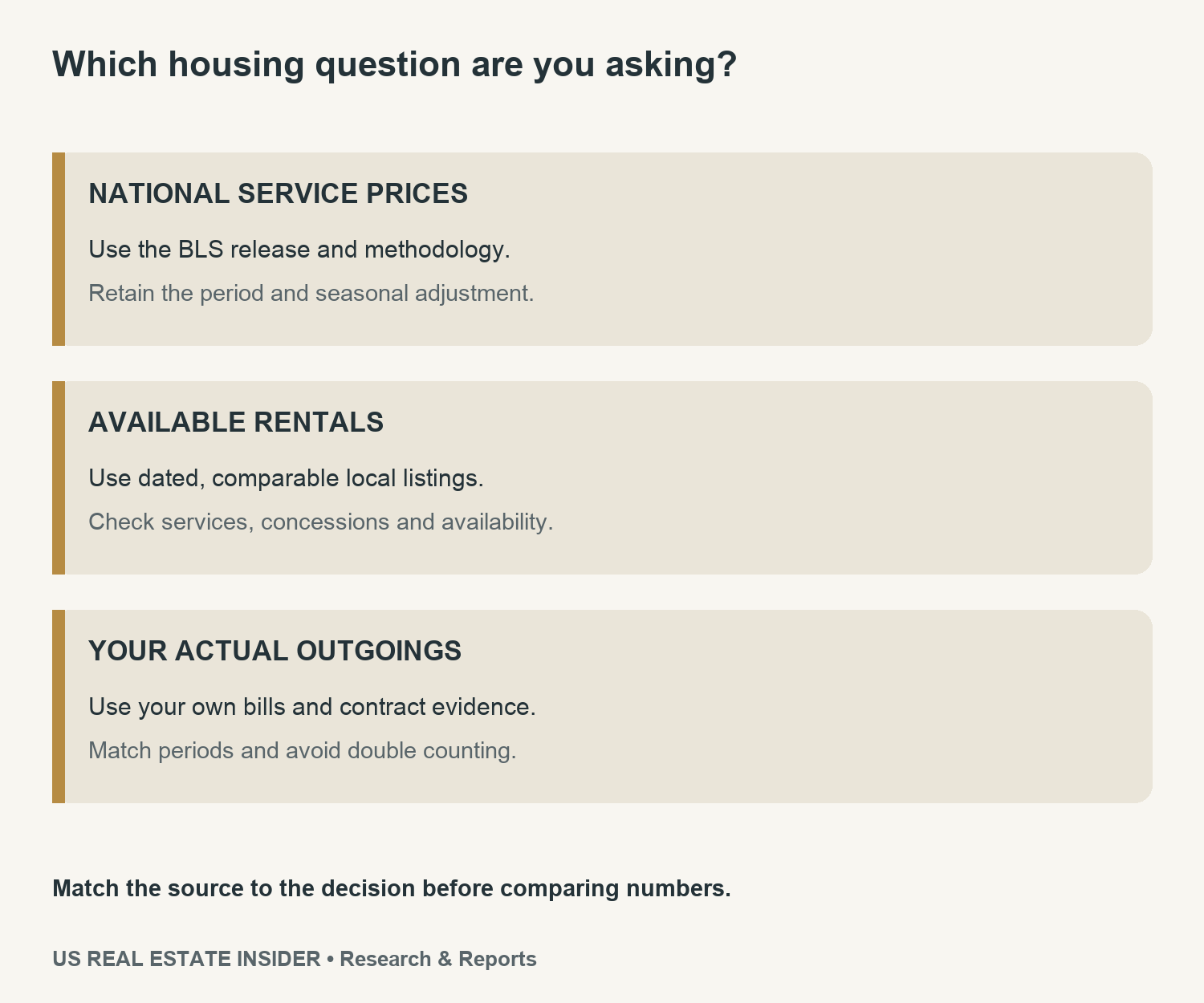
Start with a sentence that defines the task. “What changed in the national shelter measure?” calls for official statistics. “What could I rent nearby next month?” calls for current comparable listings. “How much more cash do I need?” calls for a dated payment plan.
This first sentence prevents a common spreadsheet error: combining convenient numbers that do not measure the same thing. It also makes unknowns visible. If you have no comparable listing or missing renewal terms, record that gap rather than replacing it with the national monthly change.
Why a listing comparison needs its own checks
A useful local comparison records the advertised date, property characteristics, included services and any concession. It also checks whether the home remains available. A listing is an offer to the market, not proof that someone signed at that amount.
Meanwhile, a renewal relates to an existing arrangement with its own documents and effective dates. Compare like services and like periods before interpreting a difference. Where rights or permitted increases matter, check the applicable contract and local rules with a suitable professional; this article does not determine a lawful increase.
Do not use one national monthly reading as automatic evidence that a proposed rent is fair, affordable or legally permitted. Those conclusions require different information. Our evidence map helps organise that investigation without turning an inflation statistic into a decision rule.
Reconcile a fictional household budget line by line
Consider an invented owner budget with five monthly amounts. Principal and interest stay at $1,600, property-tax allocation rises from $300 to $330, insurance allocation rises from $150 to $180, utilities rise from $200 to $210, and the maintenance reserve stays at $150. These are teaching inputs, not observed household data.
| Fictional monthly line | Baseline | Comparison | Dollar change |
|---|---|---|---|
| Mortgage principal and interest | $1,600 | $1,600 | $0 |
| Property taxes monthly allocation | $300 | $330 | $30 |
| Home insurance monthly allocation | $150 | $180 | $30 |
| Utilities | $200 | $210 | $10 |
| Maintenance reserve | $150 | $150 | $0 |
| Total | $2,400 | $2,470 | $70 |
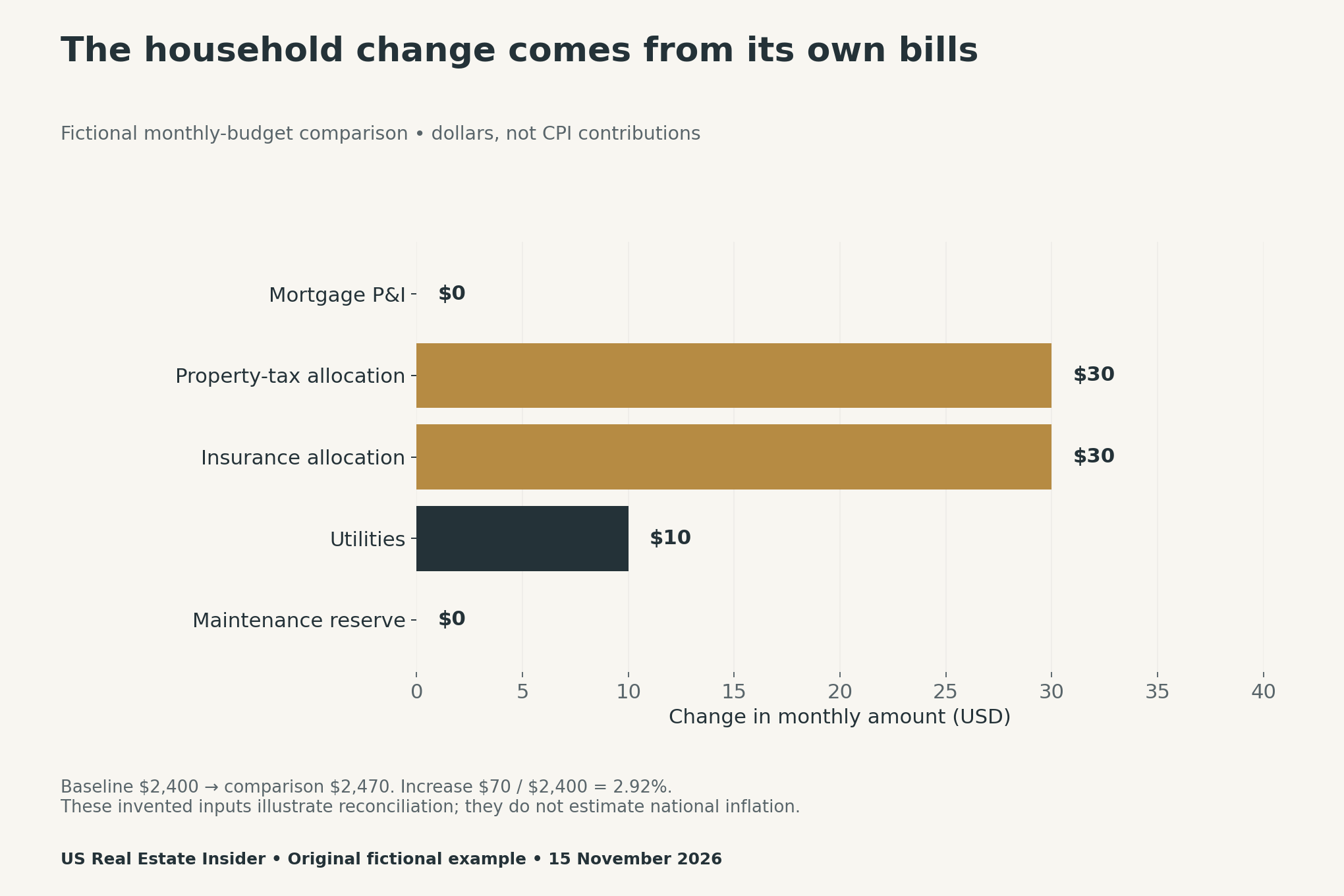
The calculation is ($2,470 − $2,400) ÷ $2,400 × 100 = 2.9167%, rounded to 2.92%. Its denominator is this fictional budget, not the BLS market basket. Changing the household inputs changes the answer; no national survey weights enter the arithmetic.
Keep payment timing separate from monthly allocation
A monthly allocation can help compare budgets, but it is different from cash leaving the account. For example, an annual insurance premium may be allocated across twelve months while its actual payment falls in one month. Keep both views clearly labelled if you need both.
Also check for double counting. If an escrow payment already includes taxes and insurance, adding those bills again as separate cash expenses would overstate the total. A reserve contribution should likewise remain separate from the later repair payment unless your method explicitly reconciles the transfer.
The blank ledger therefore has a field for “cash payment or monthly allocation.” Use that field consistently within each comparison. When switching methods, explain the change and retain the old baseline so readers can understand why the result moved.
Download the comparison files
- October national shelter measures with source and units (CSV)
- Fictional household reconciliation and arithmetic (CSV)
- Housing question and evidence map (CSV)
- Blank twelve-month housing-budget ledger (CSV)
For a purchase decision, our condo price and HOA comparison explores another mismatch between price and monthly outgoings. Our mortgage credit-availability analysis separates industry supply from an individual borrower’s fit.
Methodology and limits
We checked the archived October release and the supporting BLS factsheet on 15 November 2026. The first chart retains published seasonally adjusted monthly values. The household chart, table and reconciliation file use the same invented inputs and explicitly stated denominator.
This is a measurement guide and a reusable budgeting exercise, not a survey of households or a reconstruction of BLS weights. A single monthly reading is not an annual forecast. Local prices, household contracts, insurance and tax schedules can differ; use the documents appropriate to your own question.


