






Redfin Sunscore can help you ask better questions about a home’s sunlight, but it does not replace a room visit or a solar assessment. Start with the advertised score, then record what you actually observe at named rooms and times. Our downloadable tools turn that distinction into a repeatable viewing process.
This report combines primary-source product information with two survey charts, a four-way evidence infographic and four CSV resources. We have not visited a sample of homes or tested the model’s accuracy. The comparison protocol below is a proposed study, and its blank cells are deliberately not findings.
What Redfin Sunscore measures—and what remains untested
Redfin’s November 9, 2026 product recap describes a 0–100 property sunlight rating developed with Shadowmap. It uses three-dimensional modeling and considers structures, surrounding obstructions, terrain, time and season. The recap describes features introduced during 2026; it is not evidence of a new November launch or an independent validation study.
Treat the displayed score as a model output for the property. Keep its listing URL and capture date beside it. Do not translate an 80-point score into 80% model accuracy, eighty hours of sunlight or a specific electricity yield. Those are different quantities, and this work supplies no conversion between them.
A useful buyer question is narrower: does the information shown address the room and time that matter to you? A kitchen used before work, a desk used at noon and a patio used after work involve different observations. One property-level number cannot answer every room-level preference by itself.
Use the sunlight survey as context, not model validation
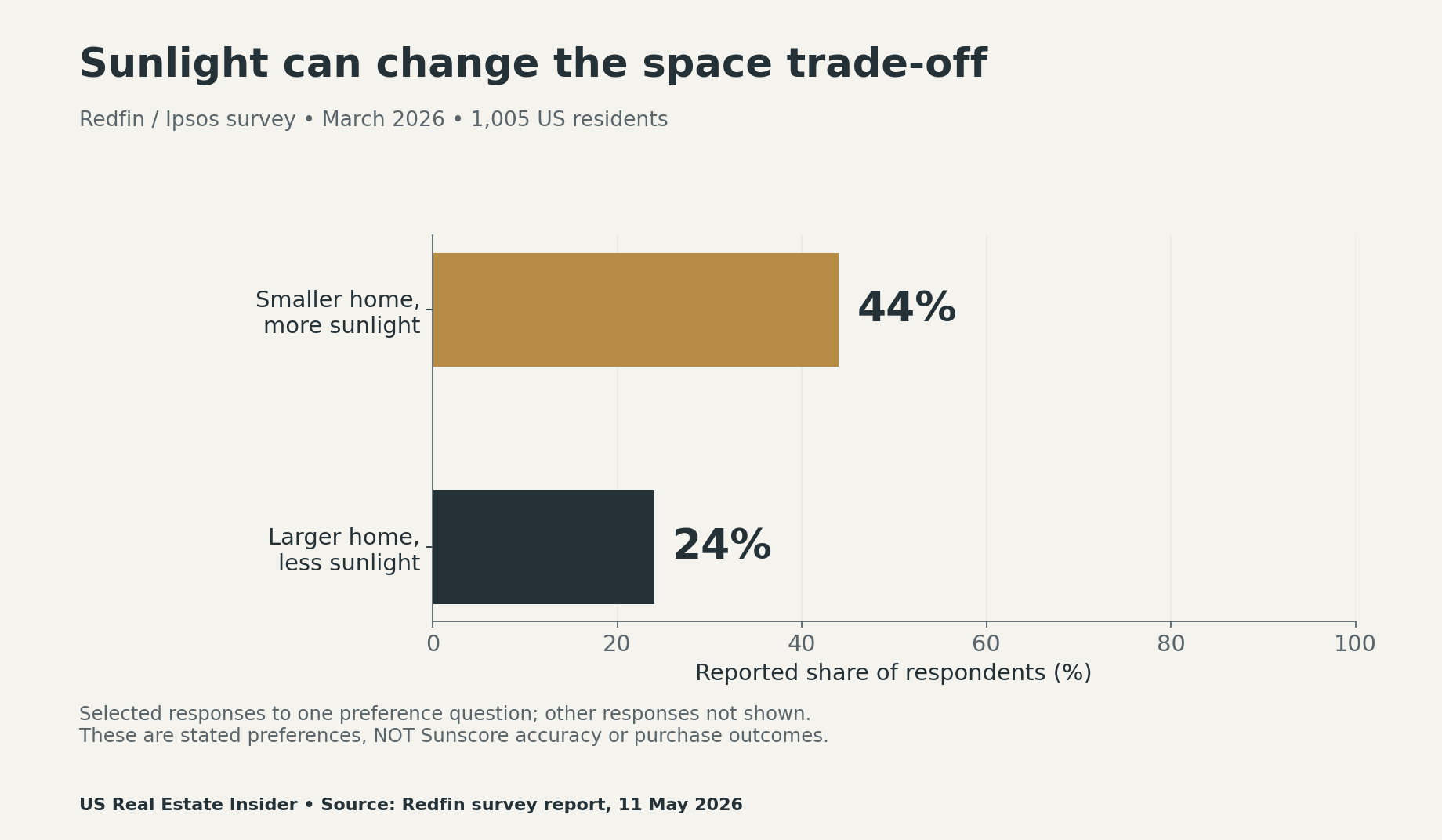
The original May 11 survey report identifies March 2026 fieldwork by Ipsos among 1,005 U.S. residents and reports a 3.8-percentage-point topline credibility interval. For a size-versus-light choice, 44% preferred a smaller, sunnier home, while 24% preferred a larger, dimmer one. Other responses are omitted from Figure 1.
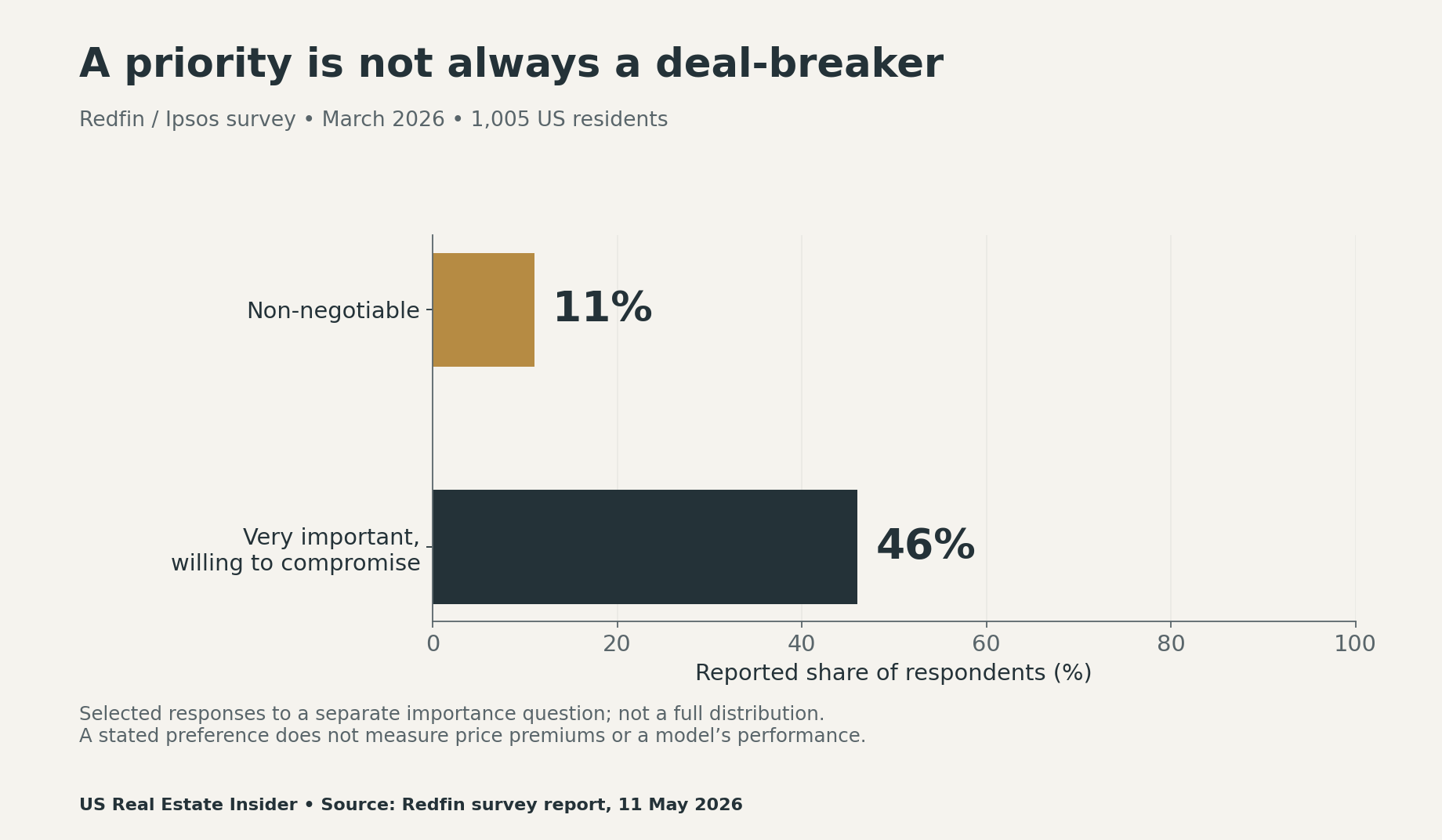
A separate question found 11% calling sunlight non-negotiable and 46% calling it very important but negotiable. Figure 2 shows those selected responses, not the full answer distribution. Do not add percentages across the two questions or treat their bars as the same respondent groups.
The report also conflicts internally: its introduction gives 67% for sunlight affecting satisfaction, while its body gives 69%. We retain both in the source audit without selecting an exact estimate. November’s “nearly 70%” summary does not resolve that conflict. Neither figure measures Sunscore accuracy, and the survey’s credibility interval is not an error bar for a listing score.
Separate four light questions before comparing homes
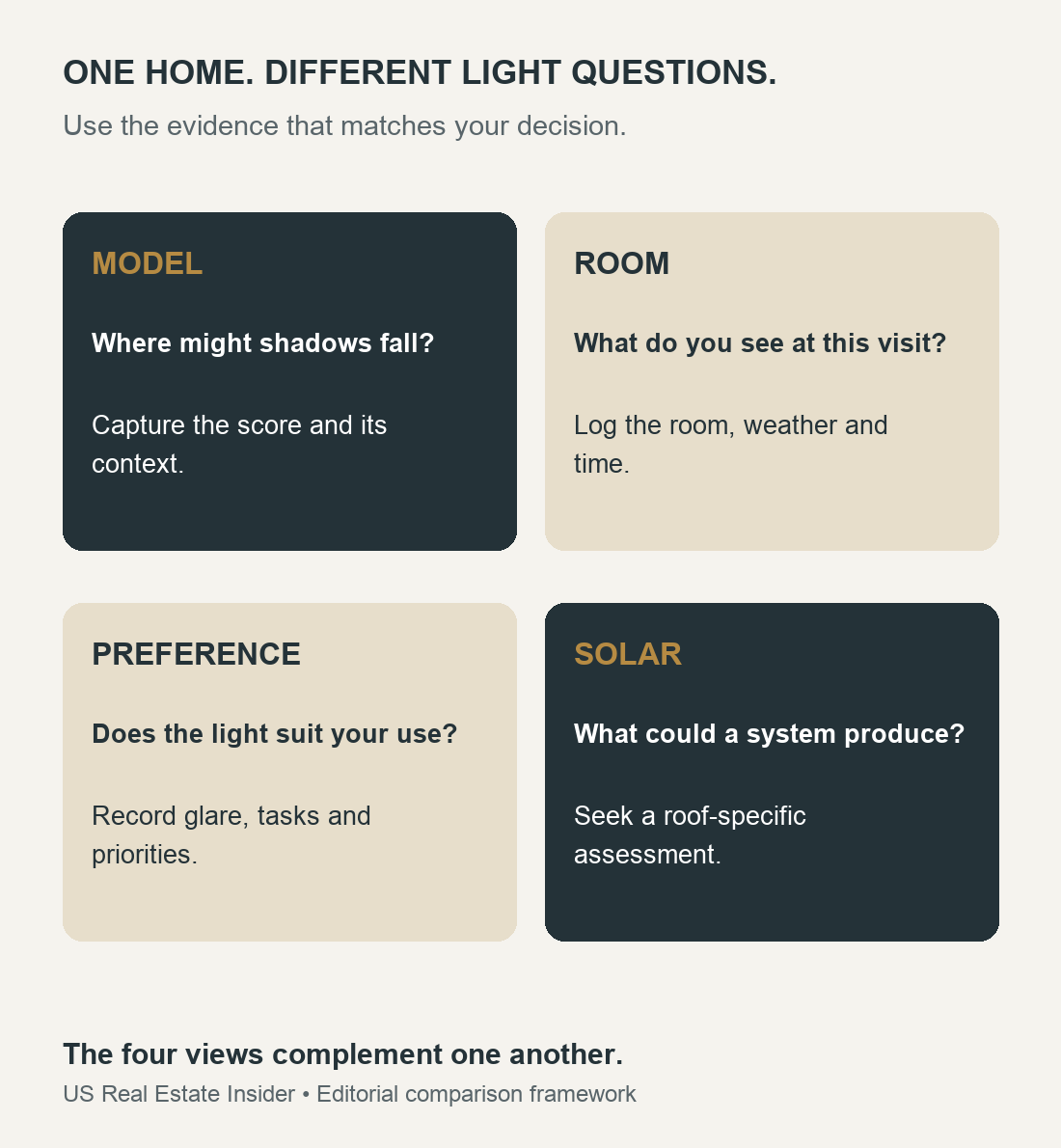
Our editorial framework separates a property model, a room observation, a personal preference and a solar-system assessment. The distinctions keep a useful listing feature from carrying a claim it has not established. Write the decision first, then choose the evidence needed to answer it.
For indoor light, name the room and the activity you care about. Record whether overhead lights are on, whether curtains are closed and whether a neighboring structure blocks a particular window. For comfort, keep subjective notes such as glare or task suitability separate from any instrument reading. A phone photograph is documentation of that visit, not a calibrated annual daylight measurement.
For energy, the U.S. Department of Energy’s solar guidance discusses roof shading, orientation, structure and electrical integration. A system assessment involves more than a general sunlight rating. Ask an appropriate professional for roof-specific work; do not infer kilowatt-hours, bill savings or payback directly from Sunscore.
Build a Redfin Sunscore viewing log that you can revisit
Before the showing, save the permitted listing reference, displayed score and capture date. Use a property alias in a shared worksheet instead of publishing an occupied home’s address. Arrange access through the owner or agent and obtain permission before photographs or repeated visits. Keep unrelated personal details out of the file.
At the visit, write the local date, time, time zone and weather before interpreting the room. Record window orientation where known and distinguish an observed obstruction from an assumed one. Mark uncertain fields as unknown. An empty cell should never silently become “no obstruction” or “no direct sun.”
Then record what you see at a named location in the room. Keep direct sun, general brightness and personal comfort as separate notes. If the model offers a dated time view, record that setting too. An observation made under different conditions may justify another question, but it does not alone prove the model is wrong.
Plan a comparison without claiming an accuracy result
The proposed-study CSV contains two fictional home aliases, three named rooms, two visit rounds and three chosen local times: 09:00, 12:00 and 15:00. Multiplying 2 × 3 × 2 × 3 gives 36 planned observations. These times are a planning illustration, not a scientific validation standard. No observations have been collected.
Use the same rooms and scheduled times across homes where access permits. Record deviations, weather and missing visits rather than filling them in. Two rounds can reveal a scheduling difference, but they cannot establish all-season performance. A larger number of rows does not by itself make a convenience sample representative.
A genuine accuracy study would first need a defined prediction target, suitable independent reference measurements, a sampling design and an analysis plan. For example, room-level brightness and modeled exterior shadow are not automatically comparable targets. Do not compute a correlation or error rate until those measurement questions are resolved.
Download the audit, blank log and proposed protocol
- Source and survey audit (CSV): reported values, dates, question groups and the unresolved satisfaction discrepancy.
- Blank sunlight viewing log (CSV): twelve blank rows for dated, permission-based room observations.
- Measurement and decision matrix (CSV): four evidence types and the limits attached to each.
- Proposed comparison schedule (CSV): 36 planned rows with no observations or accuracy findings.
The files use plain CSV values, not embedded formulas or macros. The source audit preserves reported percentages rather than reconstructing respondent counts from rounded shares. In the schedule, the combination of home alias, room, visit round and local time identifies one planned row. Preserve those identifiers when entering observations.
What to do when the score and your visit feel different
Check the capture date, viewing conditions, room and model setting first. Ask the agent to clarify the displayed information, and keep an unresolved question unresolved until there is appropriate evidence. Do not infer deliberate misrepresentation from one different-looking visit or from listing photography alone.
Light also belongs within a broader property decision. Our condo ownership-cost comparison shows how recurring obligations can change a purchase comparison. The local luxury-threshold calculator separates a market screen from property value. A sunlight score likewise supplies one input rather than a complete buying verdict.
Our contribution is a transparent way to collect better questions and comparable notes. It establishes no independent accuracy estimate, resale premium, energy saving or health benefit. Use it to prepare a more informed viewing and decide where additional measurement or professional advice is warranted.
Suggested citation: US Real Estate Insider, “Redfin Sunscore Explained: Check a Home’s Sunlight Claim,” November 11, 2026. Source audit and proposed observation tools by US Real Estate Insider; Redfin product recap dated November 9 and Ipsos survey report dated May 11, 2026.


