





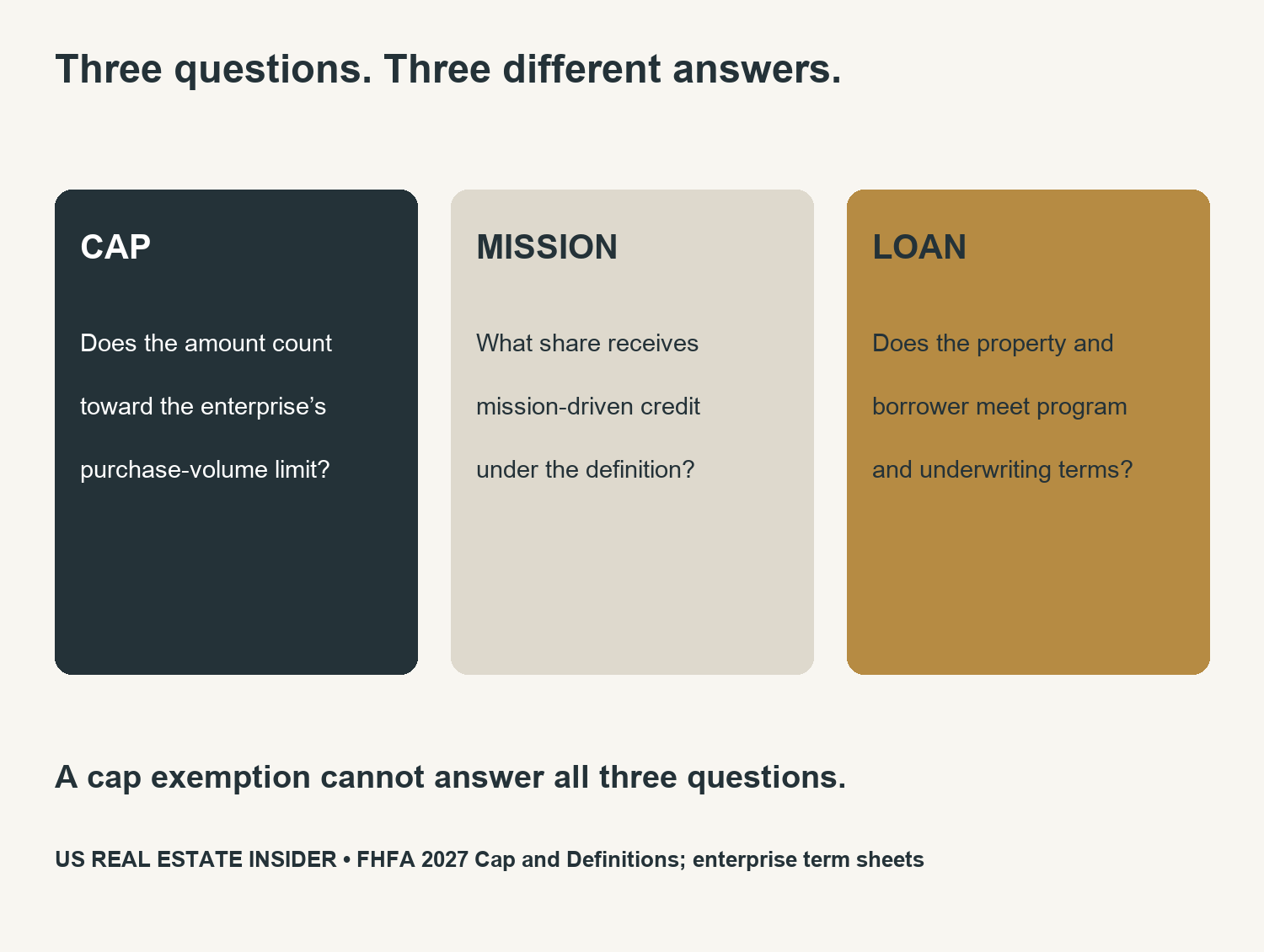
2027 multifamily loan caps and workforce housing involve two separate classifications. A qualifying workforce-housing loan can sit outside the purchase-volume cap. Mission-driven credit is another question. Neither classification tells an apartment owner how much the property can borrow or whether a lender will approve it.
FHFA’s 23 November 2026 announcement keeps the cap at $88 billion for each enterprise, or $176 billion combined. Our three-case comparison repeats one fictional $10 million request to show cap accounting. It is a classification exercise, not three loans, a financing offer or a calculation of borrowing capacity.
2027 multifamily loan caps: what the headline measures
The FHFA announcement retains the minimum 50% mission-driven requirement. It excludes qualifying workforce-housing financing from the caps, while other mission-driven loans remain capped. The $88 billion figure concerns each enterprise’s purchase volume in calendar 2027. It is not the maximum available to one borrower.
| Measure | 2027 headline | Keep separate |
|---|---|---|
| Fannie Mae purchase cap | $88 billion | Property loan-size assessment |
| Freddie Mac purchase cap | $88 billion | Borrower approval |
| Combined capped volume | $176 billion | Uncapped qualifying workforce business |
| Mission-driven minimum | 50% | The separate amount credited on a loan |
Repeat one fictional request across three classifications
Imagine the same $10 million request being tested under three different outcomes. In case A, we stipulate that the loan qualifies for the workforce cap exclusion. By contrast, case B is other mission-driven business that remains capped. Finally, case C is other capped business. The table does not establish that a real proposal qualifies for any case.
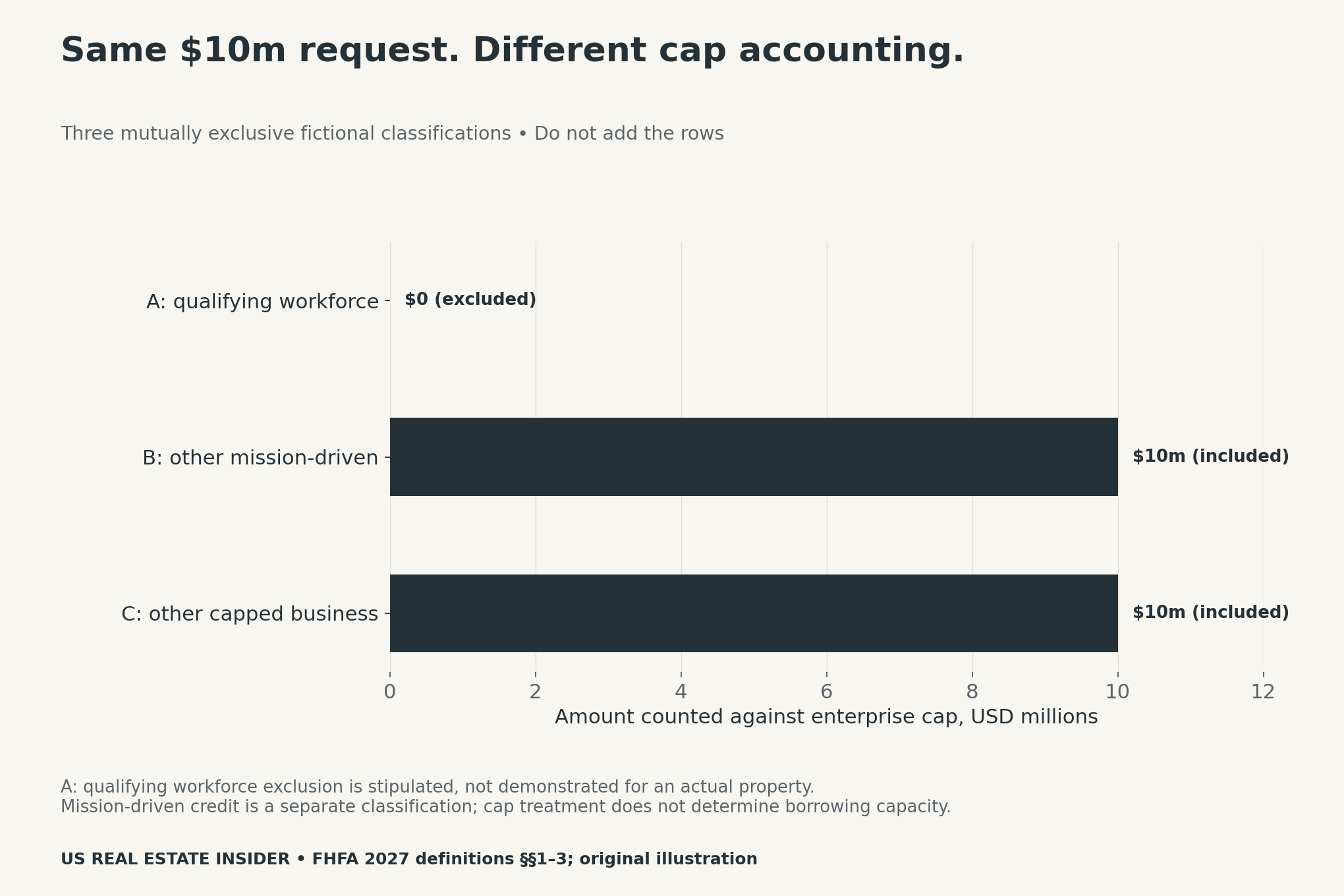
Keep the request amount and classification outcome in different columns. Otherwise, “excluded” can look like no loan was made, or “included” can look like an approval. Both readings would be wrong for this exercise. The chart describes only the accounting treatment under its stated assumptions.
Check the restriction evidence behind workforce treatment
Section 3 of the 2027 Cap and Definitions connects workforce treatment to restrictions in loan agreements. Moreover, it distinguishes the full amount excluded from the cap from the share credited as mission-driven. Restricted-unit percentages matter: the document specifies 50% mission credit below 20% restricted units and 100% at 20% or more, within the qualifying category.
This is why an affordable-looking rent roll is not enough to label every loan exempt. Instead, ask the lender to identify the applicable definition and evidence. Record the agreement, relevant units, affordability measure and duration. Leave the result unresolved if the supporting classification has not been confirmed.
Enterprise products still have their own requirements
Fannie Mae’s Sponsor-Dedicated Workforce term sheet describes a minimum 20% unit set-aside, with affordability levels depending on the market. It also lists loan-document and annual-compliance requirements. Those details show why the product assessment needs more than the national cap headline.
Freddie Mac’s Workforce Housing Preservation sheet likewise describes documented rent restrictions and annual certification. Its preservation-period wording refers to the lesser of the term or ten years, with a footnoted flexibility provision. Do not silently substitute that product wording for the FHFA definition. Ask the lender to reconcile the applicable documents and current program terms for the proposed transaction.
Therefore, the blank lender record keeps enterprise, program, unit counts, restriction duration and market measure together. Add the lender’s written cap classification and mission-credit amount separately. Then list the open underwriting items. However, a completed classification entry should not erase an unresolved appraisal, cash-flow or borrower question.
Use the worksheet without inventing a funding promise
Begin with the property and proposed enterprise execution. Next, name the program being considered. Attach the supporting restriction documents and date the evidence. Ask for the cap treatment and credited mission amount in writing. Finally, record what still needs approval and who will confirm it.
If the terms change, retain the earlier version and make a new comparison. A longer restriction period, different unit set-aside or revised program could change the evidence needed. For this reason, our worksheet leaves these entries blank so an example does not masquerade as a completed application or professional determination.
Download the cap-classification tools
- 2027 enterprise cap and mission-minimum source facts (CSV)
- Three alternative fictional cap-accounting cases (CSV)
- Blank lender classification and evidence record (CSV)
- Cap, mission credit and eligibility measure dictionary (CSV)
For a different property-finance screen, see our commercial refinance proceeds comparison. That calculation addresses loan constraints; it should not be confused with enterprise cap accounting.
Method, limitations and citation
Researched on 27 November 2026. We checked the FHFA release and definitions alongside both enterprise product sources. The $10 million cases are original, mutually exclusive illustrations with stipulated classifications. They do not assess a real property, confirm exemption or calculate available funding. Source and archive checks were targeted, not exhaustive. Confirm current documents with the lender before relying on a financing plan.
Suggested citation: US Real Estate Insider, “2027 Multifamily Loan Caps: Does Workforce Housing Count?”, 27 November 2026. Retain the cap-accounting scope and the fictional-case assumptions when reusing the assets.