





A mortgage rate lock after rates drop does not automatically become a new, lower offer. Freddie Mac’s 30-year benchmark fell from 7.28% on 19 November to 7.21% on 25 November 2026. That is useful market context. Your written loan terms, lock expiry and lender’s response still decide what you can use.
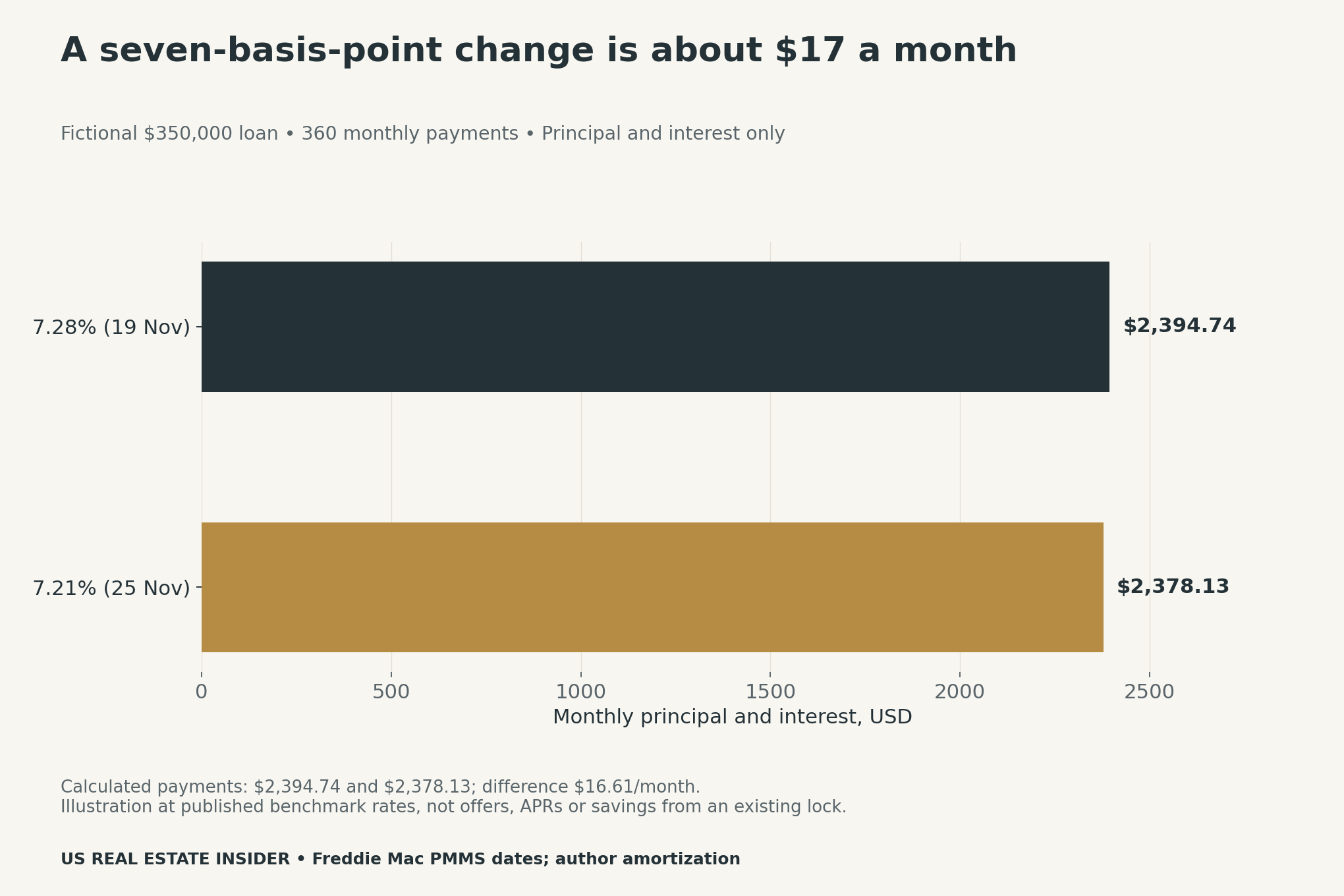
At a fictional $350,000 principal and 360 months, those rates produce about $2,395 and $2,378 in monthly principal and interest. The difference is roughly $17. Our calculation and four CSV tools help you ask a precise question without treating a national average as a personal quote.
Mortgage rate lock after rates drop: start with your status
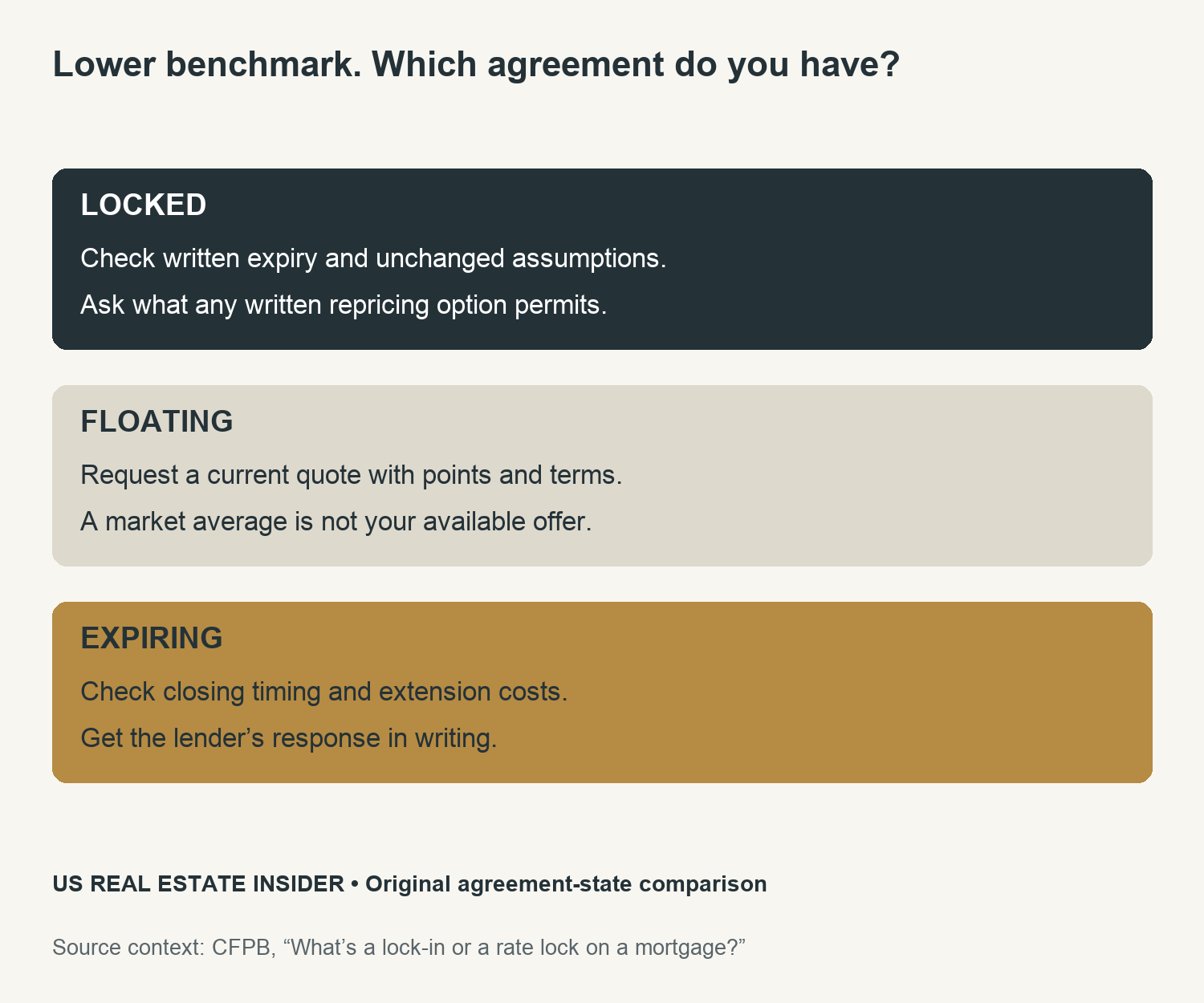
First, identify whether your rate is locked, floating or approaching expiry. Then collect the dated written terms. The CFPB’s rate-lock guidance explains that protection depends on closing within the specified period and unchanged application assumptions. A falling market rate can leave a locked borrower outside the lower pricing. Policies differ by lender.
| State | Evidence to request | Avoid assuming |
|---|---|---|
| Locked | Expiry, conditions and any written repricing option | The weekly average changes your agreement |
| Floating | Current rate, points, term and quote validity | An earlier quote remains available |
| Expiring | Closing timetable and extension policy/cost | An extension is free or guaranteed |
Record the answer instead of using a single “best rate” box. For example, a lower quoted rate with different points is a different comparison. A longer term also changes the monthly payment. Keep principal, term and points side by side so the reason for a difference remains visible.
Calculate the payment difference on equal terms
The Freddie Mac archive gives the two weekly averages. They are benchmarks from eligible loan applications, not offers to this fictional borrower. We hold the principal at $350,000 and the repayment term at 30 years. Taxes, insurance, mortgage insurance, points and other costs are excluded from the payment calculation.
For a fixed monthly payment, use M = P × r ÷ [1 − (1 + r)−n]. Here P is the loan principal, r is the annual percentage rate input divided by 1,200, and n is 360. This rate input is the stated interest rate for the illustration; the calculation does not turn it into an APR.
At 7.28%, the unrounded calculation gives $2,394.74 to the nearest cent. At 7.21%, it gives $2,378.13. Subtracting before rounding gives $16.61 per month. The rate gap is 0.07 percentage points, or seven basis points. It is not a seven-per-cent reduction in the rate.
Why the chart does not establish savings on your lock
The two bars answer one narrow question: what does changing only this rate input do to the model payment? They do not establish a lender’s repricing policy, an extension charge or the price of a new application. Keep those unknowns outside the payment result until you have evidence.
If a lender offers a written repricing option, ask for the new terms and every associated cost. Then compare the revised payment with the existing agreement on the same basis. Do not subtract a hypothetical monthly difference from an unknown fee and call it a confirmed saving. Mark missing entries as missing.
Check expiry against a realistic closing plan
The CFPB’s loan-offer guide warns that a missed lock deadline can create an extension cost, including when lender processing causes the delay. Ask about the policy before the expiry approaches. Record the date, time zone and conditions exactly as supplied rather than assuming that a calendar date explains the entire agreement.
The blank ledger includes the estimated closing date, extension cost, written repricing option and application changes. Keep the evidence reference beside each answer. If the expected closing moves, update the comparison and retain the earlier version. This makes the change visible to you and the professional helping with the transaction.
Download the rate-lock comparison tools
- Two-date Freddie Mac benchmark record (CSV)
- Fixed-principal payment calculation answer key (CSV)
- Blank written rate-lock and quote comparison ledger (CSV)
- Locked, floating and expiring question framework (CSV)
A closing plan also needs evidence about the home itself. Our new-home inventory and readiness guide separates construction status from approval and closing conditions. For the amount screen, use the county and loan-year limit comparison.
Method, assumptions and citation
Researched on 27 November 2026. We verified the 19 and 25 November PMMS entries and current CFPB guidance. The payment model uses monthly compounding and equal monthly payments, with no additional costs. Published benchmarks and original fictional calculations are identified separately. Targeted archive checks were not exhaustive. This worksheet supports a documented conversation; it does not decide eligibility or replace a lender’s written terms.
Suggested citation: US Real Estate Insider, “Mortgage Rates Fell This Week. Did Your Rate Lock Change?”, 27 November 2026. Retain the fictional-loan assumptions and the distinction between a benchmark and an available offer when reusing the chart.