





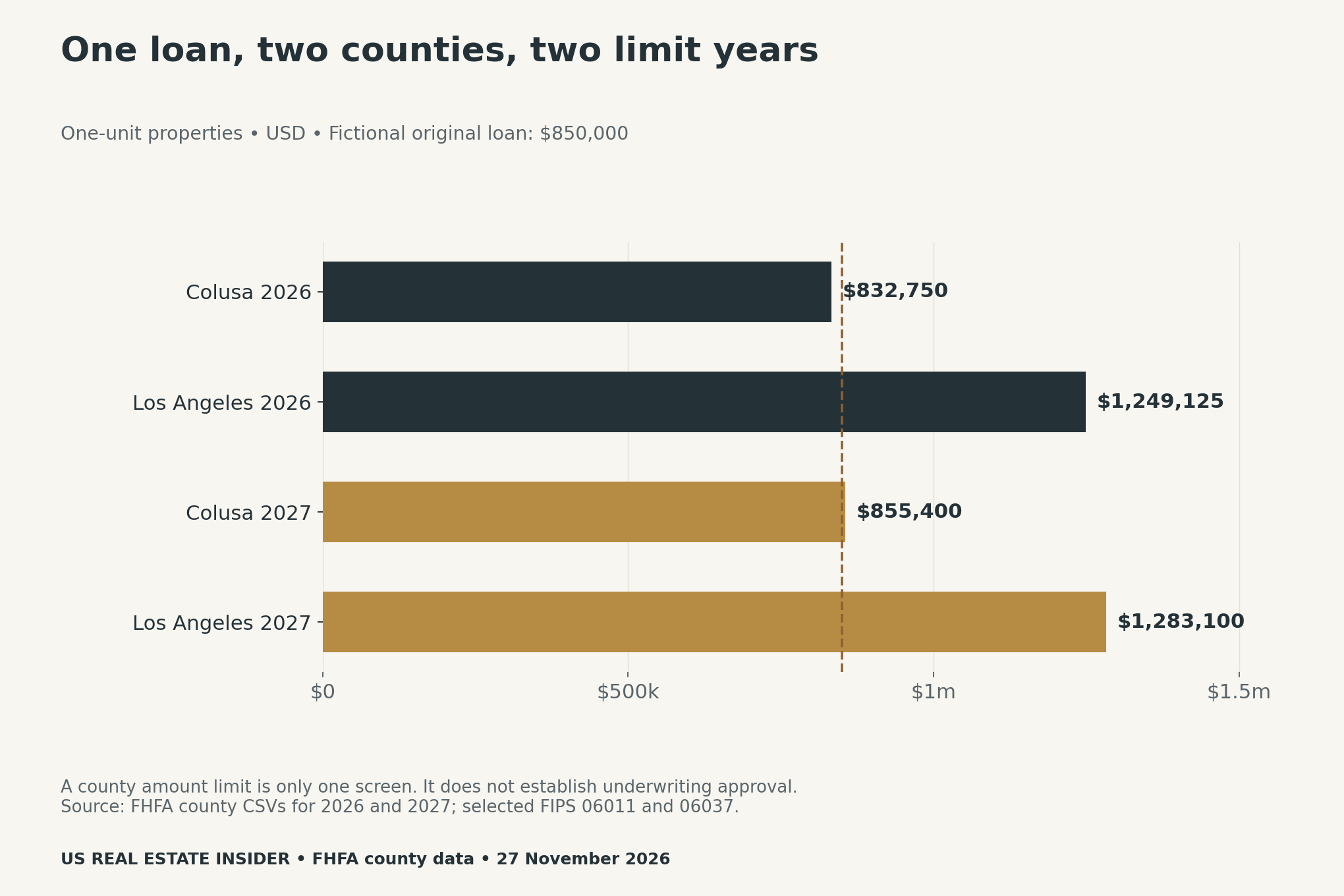
2027 conforming loan limits by county can change an amount comparison without changing the loan itself. In our example, an original one-unit loan of $850,000 is $17,250 above Colusa County’s 2026 limit but $5,400 below its 2027 limit. In Los Angeles County, that amount is within the county limit in both years. This is an amount screen, not a lending decision.
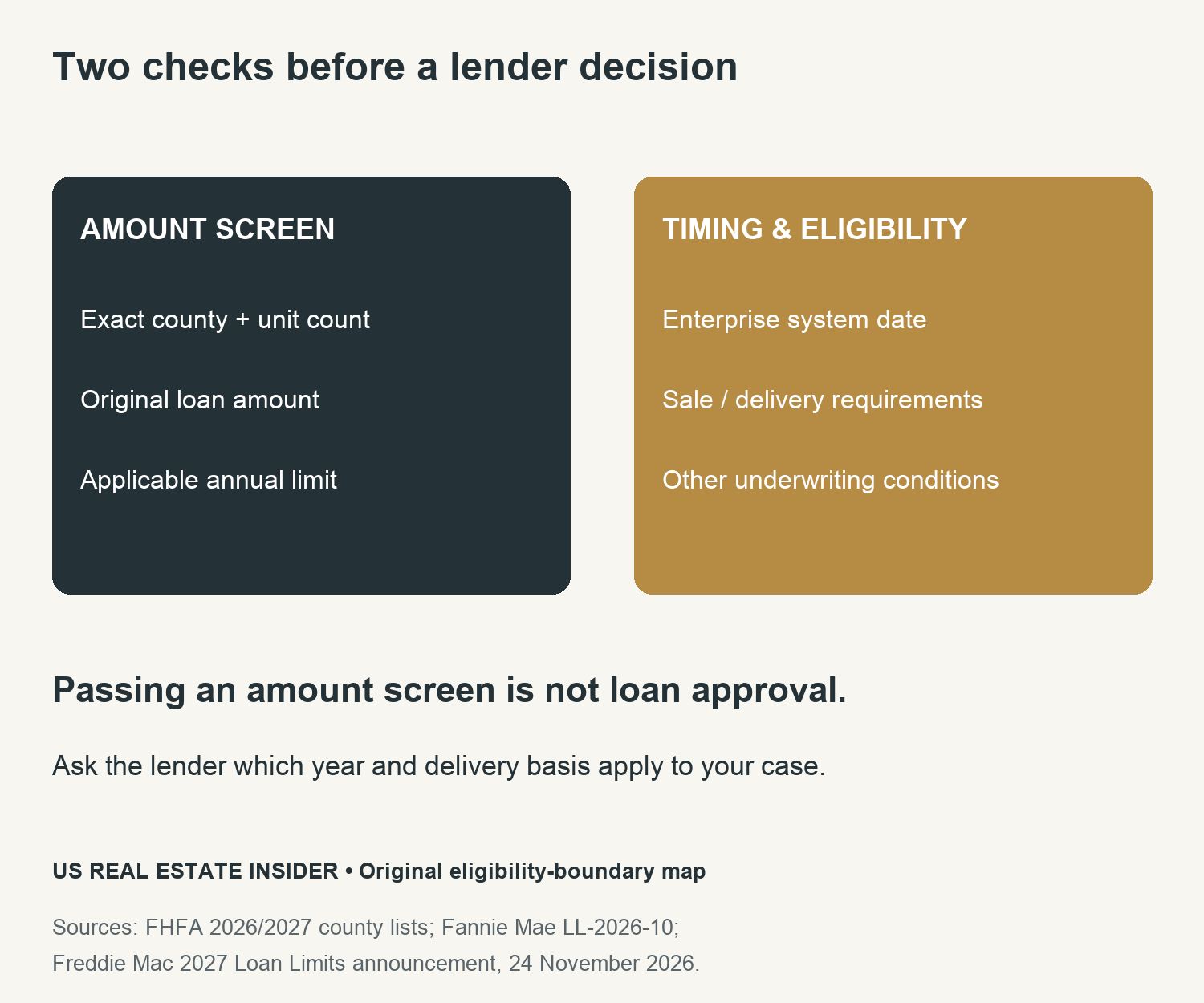
Use the county, number of units, original loan amount and applicable limit year together. Then ask the lender which enterprise rules and timing apply. Our downloadable comparison uses two California counties to show the method; it is not a nationwide eligibility tool or a mortgage offer.
2027 conforming loan limits by county: compare like with like
FHFA’s 24 November announcement sets the 2027 one-unit baseline at $855,400, up $22,650 from 2026. The standard high-cost ceiling is $1,283,100. However, the ceiling is not a universal county limit. Look up the property’s actual county and unit count in the official annual county files.
| County / one unit | 2026 limit | 2027 limit | Illustrative original loan |
|---|---|---|---|
| Colusa, California | $832,750 | $855,400 | $850,000 |
| Los Angeles, California | $1,249,125 | $1,283,100 | $850,000 |
Calculate the margin and keep the sign
Subtract the original loan amount from the applicable limit. A positive result means the amount is below the limit; a negative result means it is above. For Colusa in 2026, $832,750 minus $850,000 equals −$17,250. For 2027, $855,400 minus $850,000 equals $5,400. Those two margins answer the same narrow question using different annual limits.
For comparison, the Los Angeles margins are $399,125 in 2026 and $433,100 in 2027. A larger margin does not show that the property is affordable or that a borrower will qualify. It only describes the difference between the selected county limit and our invented original loan amount.
Original amount is not today’s remaining balance
Fannie Mae’s Lender Letter LL-2026-10 applies these limits to the mortgage’s original amount, rather than its balance when Fannie Mae purchases it. Therefore, a balance that has fallen below a threshold is not enough to repeat our example. Confirm which amount the lender is using and retain that explanation in writing.
Also, do not substitute the purchase price for the loan amount. A price, a deposit and an original mortgage amount are different entries. The worksheet keeps the amount field explicit so a buyer educator can spot a mismatch before discussing a county comparison.
December system dates and January delivery rules differ
Fannie Mae says its 2027 limits apply in Desktop Underwriter to casefiles submitted or resubmitted on or after the weekend of 5 December 2026. Its new limits are effective for whole-loan delivery and MBS pool issue dates on or after 1 January 2027, with specific December-delivery and purchase-status distinctions in the letter. Read those terms with the lender rather than treating the application date as the only date that matters.
Meanwhile, Freddie Mac’s 24 November notice schedules its Loan Product Advisor update for 6 December. It states that loans above the 2026 limits but within the higher 2027 limits are not eligible for sale to Freddie Mac until on or after 1 January 2027. The system update and sale eligibility are separate events.
Questions to put in the lender’s written answer
First, ask which county and unit count the lender recorded. Next, ask for the annual amount limit and its official source. Then confirm the original amount used in the comparison. Finally, ask which enterprise, system-submission timing and sale or delivery conditions support the lender’s chosen limit year.
Keep the response with the quote or case record. If a date or amount changes, revisit the relevant entry instead of assuming the old answer still applies. An application date or closing date alone should not replace the lender’s explanation of the applicable enterprise requirements.
Download the county and timing worksheets
- Two-county limits for one to four units, 2026 and 2027 (CSV)
- Fictional $850,000 loan comparison and margins (CSV)
- Blank county, amount and timing verification sheet (CSV)
- Enterprise implementation calendar with qualifications (CSV)
For a separate financing boundary, read our mortgage credit availability and borrower eligibility guide. It explains why a wider market indicator is not an individual approval.
Method, source precision and limits
Researched on 27 November 2026. We downloaded the official 2026 and 2027 FHFA CSVs, selected FIPS 06011 and 06037, retained one-to-four-unit limits and computed one-unit margins using an invented $850,000 original amount. All dollar arithmetic uses the displayed integer limits. No borrower, lender quote, affordability calculation or underwriting system was tested. Archive checks were targeted, not exhaustive.
Suggested citation: US Real Estate Insider, “2027 Conforming Loan Limits: Check Your County and Loan Year”, 27 November 2026. Preserve the one-unit, county, annual-limit and fictional-loan qualifications when reusing the comparison.


